

C_ABAPD_2309 100% Guarantee Download C_ABAPD_2309 Exam PDF Q&A [Dec 23, 2024]
Get C_ABAPD_2309 Actual Free Exam Q&As to Prepare for Your SAP Certification
NEW QUESTION # 38
What RESTful Application Programming feature is used to ensure the uniqueness of a semantic key?
- A. Determination
- B. Validation
- C. Action
Answer: A
Explanation:
Explanation
The RESTful Application Programming feature that is used to ensure the uniqueness of a semantic key is determination. A determination is a type of behavior implementation that defines a logic that is executed automatically when certain events occur, such as create, update, delete, or activate. A determination can be used to calculate or derive values for certain fields, such as semantic keys, based on other fields or external sources. A determination can also be used to check the uniqueness of a semantic key by comparing it with the existing values in the database or the transaction buffer. A determination can use the ABAP SQL or the EML syntax to access and manipulate data. A determination can be defined using the DETERMINE action clause in the behavior definition of a CDS view entity or a projection view. A determination can also be annotated with the @ObjectModel.determination annotation to specify the event, the timing, and the scope of the determination12 The other RESTful Application Programming features are not used to ensure the uniqueness of a semantic key, but have different purposes and effects. These features are:
Validation: A validation is a type of behavior implementation that defines a logic that is executed automatically when certain events occur, such as create, update, delete, or activate. A validation can be used to check the consistency and correctness of the data, such as mandatory fields, data types, value ranges, or business rules. A validation can use the ABAP SQL or the EML syntax to access and manipulate data. A validation can be defined using the VALIDATE action clause in the behavior definition of a CDS view entity or a projection view. A validation can also be annotated with the
@ObjectModel.validation annotation to specify the event, the timing, and the scope of the validation12 Action: An action is a type of behavior implementation that defines a logic that is executed explicitly by the user or the application. An action can be used to perform a specific business operation, such as creating, updating, deleting, or activating an entity instance, or triggering a workflow or a notification.
An action can use the ABAP SQL or the EML syntax to access and manipulate data. An action can be defined using the ACTION clause in the behavior definition of a CDS view entity or a projection view. An action can also be annotated with the @ObjectModel.action annotation to specify the name, the description, the parameters, and the visibility of the action12 References: Behavior Implementation - ABAP Keyword Documentation, Behavior Definition - ABAP Keyword Documentation
NEW QUESTION # 39
What are the effects of this annotation? Note: There are 2 correct answers to this question.
- A. You can still override the default value with a value of your own.
- B. The value of sy-langu will be passed to the CDS view automatically both when you use the -1 CDS view in ABAP and in another CDS view entity (view on view).
- C. The value of sy-langu will be passed to the CDS view automatically when you use the CDS view in ABAP but not when you use it in another view entity
- D. It is no longer possible to pass your own value to the parameter.
Answer: A,B
Explanation:
The annotation @Environment.systemField: #LANGUAGE is used to assign the ABAP system field sy-langu to an input parameter of a CDS view or a CDS table function. This enables the implicit parameter passing in Open SQL, which means that the value of sy-langu will be automatically passed to the CDS view without explicitly specifying it in the WHERE clause. This also applies to the CDS views that use the annotated CDS view as a data source, which means that the value of sy-langu will be propagated to the nested CDS views (view on view)12. For example:
* The following code snippet defines a CDS view ZI_FLIGHT_TEXTS with an input parameter p_langu that is annotated with @Environment.systemField: #LANGUAGE:
define view ZI_FLIGHT_TEXTS with parameters p_langu : syst_langu @<Environment.systemField:
#LANGUAGE as select from sflight left outer join scarr on sflight.carrid = scarr.carrid left outer join stext on scarr.carrid = stext.carrid { sflight.carrid, sflight.connid, sflight.fldate, scarr.carrname, stext.text as carrtext } where stext.langu = :p_langu
* The following code snippet shows how to use the CDS view ZI_FLIGHT_TEXTS in ABAP without specifying the value of p_langu in the WHERE clause. The value of sy-langu will be automatically passed to the CDS view:
SELECT carrid, connid, fldate, carrname, carrtext FROM zi_flight_texts INTO TABLE @DATA(lt_flights).
* The following code snippet shows how to use the CDS view ZI_FLIGHT_TEXTS in another CDS view ZI_FLIGHT_REPORT. The value of sy-langu will be automatically passed to the nested CDS view ZI_FLIGHT_TEXTS:
define view ZI_FLIGHT_REPORT with parameters p_langu : syst_langu @<Environment.systemField:
#LANGUAGE as select from zi_flight_texts(p_langu) { carrid, connid, fldate, carrname, carrtext, count(*) as flight_count } group by carrid, connid, fldate, carrname, carrtext The annotation @Environment.systemField: #LANGUAGE does not prevent the possibility of overriding the default value with a value of your own. You can still specify a different value for the input parameter p_langu in the WHERE clause, either in ABAP or in another CDS view. This will override the value of sy-langu and pass the specified value to the CDS view12. For example:
* The following code snippet shows how to use the CDS view ZI_FLIGHT_TEXTS in ABAP with a specified value of p_langu in the WHERE clause. The value 'E' will be passed to the CDS view instead of the value of sy-langu:
SELECT carrid, connid, fldate, carrname, carrtext FROM zi_flight_texts WHERE p_langu = 'E' INTO TABLE @DATA(lt_flights).
* The following code snippet shows how to use the CDS view ZI_FLIGHT_TEXTS in another CDS view ZI_FLIGHT_REPORT with a specified value of p_langu in the WHERE clause. The value 'E' will be passed to the nested CDS view ZI_FLIGHT_TEXTS instead of the value of sy-langu:
define view ZI_FLIGHT_REPORT with parameters p_langu : syst_langu @<Environment.systemField:
#LANGUAGE as select from zi_flight_texts(p_langu) { carrid, connid, fldate, carrname, carrtext, count(*) as flight_count } where p_langu = 'E' group by carrid, connid, fldate, carrname, carrtext References: 1: ABAP CDS - parameter_annot - ABAP Keyword Documentation - SAP Online Help 2: ABAP CDS - session_variable - ABAP Keyword Documentation - SAP Online Help
NEW QUESTION # 40
What RESTful Application Programming feature is used to ensure the uniqueness of a semantic key?
- A. Determination
- B. Validation
- C. Action
Answer: A
Explanation:
The RESTful Application Programming feature that is used to ensure the uniqueness of a semantic key is determination. A determination is a type of behavior implementation that defines a logic that is executed automatically when certain events occur, such as create, update, delete, or activate. A determination can be used to calculate or derive values for certain fields, such as semantic keys, based on other fields or external sources. A determination can also be used to check the uniqueness of a semantic key by comparing it with the existing values in the database or the transaction buffer. A determination can use the ABAP SQL or the EML syntax to access and manipulate data. A determination can be defined using the DETERMINE action clause in the behavior definition of a CDS view entity or a projection view. A determination can also be annotated with the @ObjectModel.determination annotation to specify the event, the timing, and the scope of the determination12 The other RESTful Application Programming features are not used to ensure the uniqueness of a semantic key, but have different purposes and effects. These features are:
Validation: A validation is a type of behavior implementation that defines a logic that is executed automatically when certain events occur, such as create, update, delete, or activate. A validation can be used to check the consistency and correctness of the data, such as mandatory fields, data types, value ranges, or business rules. A validation can use the ABAP SQL or the EML syntax to access and manipulate data. A validation can be defined using the VALIDATE action clause in the behavior definition of a CDS view entity or a projection view. A validation can also be annotated with the @ObjectModel.validation annotation to specify the event, the timing, and the scope of the validation12 Action: An action is a type of behavior implementation that defines a logic that is executed explicitly by the user or the application. An action can be used to perform a specific business operation, such as creating, updating, deleting, or activating an entity instance, or triggering a workflow or a notification. An action can use the ABAP SQL or the EML syntax to access and manipulate data. An action can be defined using the ACTION clause in the behavior definition of a CDS view entity or a projection view. An action can also be annotated with the @ObjectModel.action annotation to specify the name, the description, the parameters, and the visibility of the action12
NEW QUESTION # 41
Exhibit: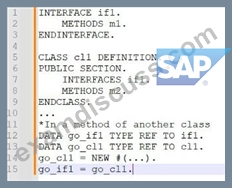
What are valid statements? Note: There are 3 correct answers to this question.
- A. Instead of go_cll = NEW #() you could use go_iff - NEW #(...).
- B. go_ifl may call method m2 with go if->m2(...).
- C. go_cll may call method ml with go_dl->ifl-ml().
- D. Instead of go ell = NEW #(...) you could use go ifl = NEW cll(. ... ).
- E. go_if 1 may call method ml with go_ift->ml().
Answer: B,D,E
Explanation:
The following are the explanations for each statement:
A: This statement is valid. go_ifl may call method ml with go_ifl->ml(). This is because go_ifl is a data object of type REF TO ifl, which is a reference to the interface ifl. The interface ifl defines a method ml, which can be called using the reference variable go_ifl. The class cll implements the interface ifl, which means that it provides an implementation of the method ml. The data object go_ifl is assigned to a new instance of the class cll using the NEW operator and the inline declaration operator @DATA. Therefore, when go_ifl->ml() is called, the implementation of the method ml in the class cll is executed123 B: This statement is valid. Instead of go_cll = NEW #(...) you could use go_ifl = NEW cll(...). This is because go_ifl is a data object of type REF TO ifl, which is a reference to the interface ifl. The class cll implements the interface ifl, which means that it is compatible with the interface ifl. Therefore, go_ifl can be assigned to a new instance of the class cll using the NEW operator and the class name cll. The inline declaration operator @DATA is optional in this case, as go_ifl is already declared. The parentheses after the class name cll can be used to pass parameters to the constructor of the class cll, if any123 E: This statement is valid. go_ifl may call method m2 with go_ifl->m2(...). This is because go_ifl is a data object of type REF TO ifl, which is a reference to the interface ifl. The class cll implements the interface ifl, which means that it inherits all the components of the interface ifl. The class cll also defines a method m2, which is a public method of the class cll. Therefore, go_ifl can call the method m2 using the reference variable go_ifl. The method m2 is not defined in the interface ifl, but it is accessible through the interface ifl, as the interface ifl is implemented by the class cll. The parentheses after the method name m2 can be used to pass parameters to the method m2, if any123 The other statements are not valid, as they have syntax errors or logical errors. These statements are:
C: This statement is not valid. go_cll may call method ml with go_cll->ifl~ml(). This is because go_cll is a data object of type REF TO cll, which is a reference to the class cll. The class cll implements the interface ifl, which means that it inherits all the components of the interface ifl. The interface ifl defines a method ml, which can be called using the reference variable go_cll. However, the syntax for calling an interface method using a class reference is go_cll->ml(), not go_cll->ifl~ml(). The interface component selector ~ is only used when calling an interface method using an interface reference, such as go_ifl->ifl~ml(). Using the interface component selector ~ with a class reference will cause a syntax error123 D: This statement is not valid. Instead of go_cll = NEW #() you could use go_ifl = NEW #(...). This is because go_ifl is a data object of type REF TO ifl, which is a reference to the interface ifl. The interface ifl cannot be instantiated, as it does not have an implementation. Therefore, go_ifl cannot be assigned to a new instance of the interface ifl using the NEW operator and the inline declaration operator @DATA. This will cause a syntax error or a runtime error. To instantiate an interface, you need to use a class that implements the interface, such as the class cll123
NEW QUESTION # 42
What are advantages of using a field symbol for internal table row access? Note: There are answers to this question.
- A. The field symbol can be reused for other programs.
- B. A MODIFY statement to write changed contents back to the table is not required.
- C. The row content is copied to the field symbol instead to a work area
- D. Using a field symbol is faster than using a work area.
Answer: B,D
Explanation:
A field symbol is a pointer that allows direct access to a row of an internal table without copying it to a work area. Using a field symbol for internal table row access has some advantages over using a work area, such as12:
A MODIFY statement to write changed contents back to the table is not required: This is true. When you use a work area, you have to copy the row content from the internal table to the work area, modify it, and then copy it back to the internal table using the MODIFY statement. This can be costly in terms of performance and memory consumption. When you use a field symbol, you can modify the row content directly in the internal table without any copying. Therefore, you do not need the MODIFY statement12.
Using a field symbol is faster than using a work area: This is true. As explained above, using a field symbol avoids the overhead of copying data between the internal table and the work area. This can improve the performance of the loop considerably, especially for large internal tables. According to some benchmarks, using a field symbol can save 25-40% of the runtime compared to using a work area12.
You cannot do any of the following:
The field symbol can be reused for other programs: This is false. A field symbol is a local variable that is only visible within the scope of its declaration. It cannot be reused for other programs unless it is declared globally or passed as a parameter. Moreover, a field symbol must have the same type as the line type of the internal table that it accesses. Therefore, it cannot be used for any internal table with a different line type12.
The row content is copied to the field symbol instead to a work area: This is false. As explained above, using a field symbol does not copy the row content to the field symbol. Instead, the field symbol points to the memory address of the row in the internal table and allows direct access to it. Therefore, there is no copying involved when using a field symbol12.
NEW QUESTION # 43
You have a superclass superl and a subclass subl of superl. Each class has an instance constructor and a static constructor. The first statement of your program creates an instance of subl. In which sequence will the constructors be executed?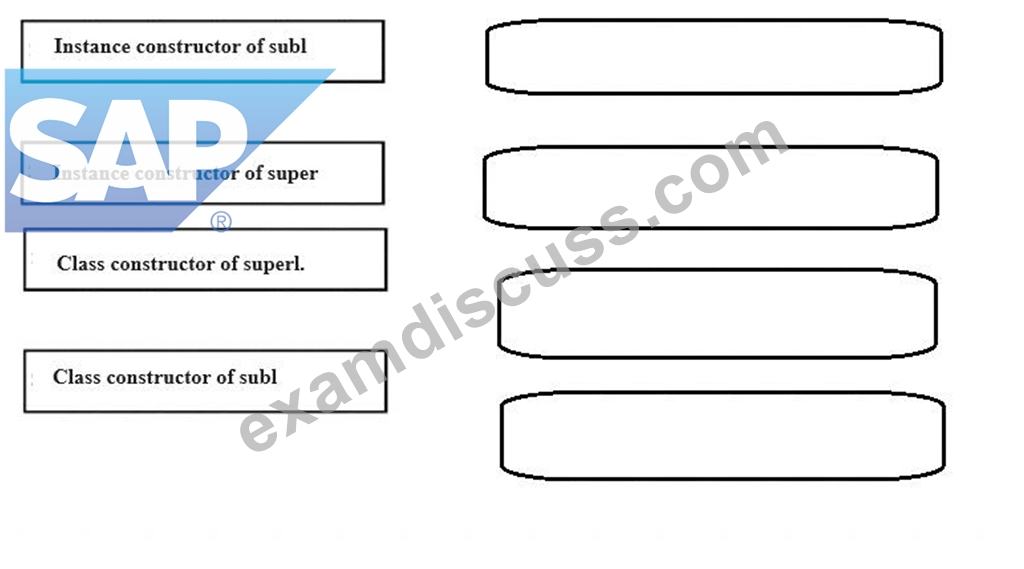
Answer:
Explanation: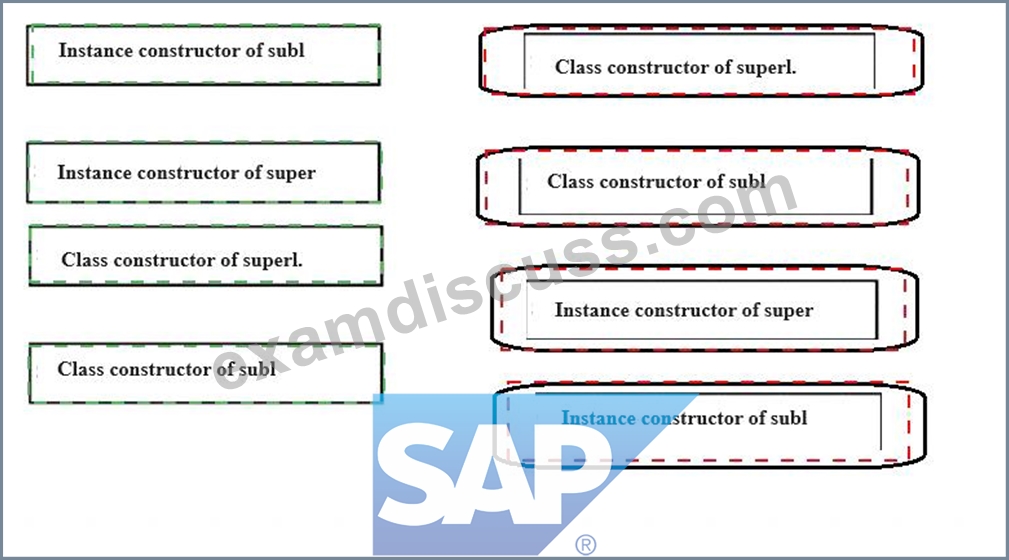
Explanation:
The sequence in which the constructors will be executed is as follows:
* Class constructor of superl. This is because the class constructor is a static method that is executed automatically before the class is accessed for the first time. The class constructor is used to initialize the static attributes and components of the class. The class constructor of the superclass is executed before the class constructor of the subclass, as the subclass inherits the static components of the superclass12
* Class constructor of subl. This is because the class constructor is a static method that is executed automatically before the class is accessed for the first time. The class constructor is used to initialize the static attributes and components of the class. The class constructor of the subclass is executed after the class constructor of the superclass, as the subclass inherits the static components of the superclass12
* Instance constructor of superl. This is because the instance constructor is an instance method that is executed automatically when an instance of the class is created using the statement CREATE OBJECT.
The instance constructor is used to initialize the instance attributes and components of the class. The instance constructor of the superclass is executed before the instance constructor of the subclass, as the subclass inherits the instance components of the superclass. The instance constructor of the subclass must call the instance constructor of the superclass explicitly using super->constructor, unless the superclass is the root node object12
* Instance constructor of subl. This is because the instance constructor is an instance method that is executed automatically when an instance of the class is created using the statement CREATE OBJECT.
The instance constructor is used to initialize the instance attributes and components of the class. The instance constructor of the subclass is executed after the instance constructor of the superclass, as the subclass inherits the instance components of the superclass. The instance constructor of the subclass must call the instance constructor of the superclass explicitly using super->constructor, unless the superclass is the root node object12 References: Constructors of Classes - ABAP Keyword Documentation, METHODS - constructor - ABAP Keyword Documentation
NEW QUESTION # 44
In ABAP SQL, which of the following can be assigned an alias? Note: There are 2 correct answers to this question.
- A. order criterion (from order by clause)
- B. group criterion (from group by clause)
- C. database table
- D. field (from field list)
Answer: C,D
Explanation:
In ABAP SQL, an alias is a temporary name that can be assigned to a field or a database table in a query. An alias can be used to make the query more readable, to avoid name conflicts, or to access fields or tables with long names. An alias is created with the AS keyword and is only valid for the duration of the query1.
The following are examples of how to assign an alias to a field or a database table in ABAP SQL:
* B. field (from field list): A field is a column of a table or a view that contains data of a certain type. A field can be assigned an alias in the field list of a SELECT statement, which specifies the fields that are selected from the data source. For example, the following query assigns the alias name to the field carrname of the table scarr:
SELECT carrid, carrname AS name FROM scarr.
The alias name can be used instead of carrname in other clauses of the query, such as WHERE, GROUP BY, ORDER BY, and so on2.
* C. database table: A database table is a collection of data that is organized in rows and columns. A database table can be assigned an alias in the FROM clause of a SELECT statement, which specifies the data source that is selected from. For example, the following query assigns the alias c to the table scarr:
SELECT c.carrid, c.carrname FROM scarr AS c.
The alias c can be used instead of scarr in other clauses of the query, such as WHERE, JOIN, GROUP BY, ORDER BY, and so on3.
The following are not valid for assigning an alias in ABAP SQL:
* A. order criterion (from order by clause): An order criterion is a field or an expression that is used to sort the result set of a query in ascending or descending order. An order criterion cannot be assigned an alias in the ORDER BY clause of a SELECT statement, because the alias is not visible in this clause. The alias can only be used in the clauses that follow the clause where it is defined1.
* D. group criterion (from group by clause): A group criterion is a field or an expression that is used to group the result set of a query into subsets that share the same values. A group criterion cannot be assigned an alias in the GROUP BY clause of a SELECT statement, because the alias is not visible in this clause. The alias can only be used in the clauses that follow the clause where it is defined1.
References: 1: ALIASES - ABAP Keyword Documentation 2: SELECT List - ABAP Keyword Documentation 3: FROM Clause - ABAP Keyword Documentation
NEW QUESTION # 45 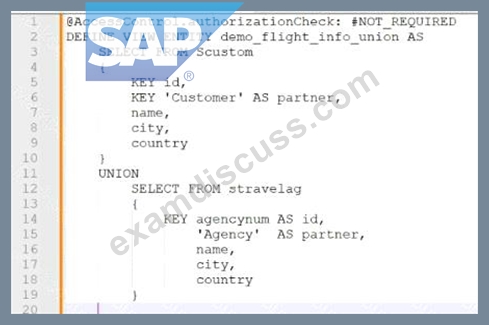
when you attempt to activate the definition, what will be the response?
- A. Activation error because the field types of the union do not match
- B. Activation error because the field names of the union do not match
- C. Activation successful
- D. Activation error because the key fields of the union do not match
Answer: B
Explanation:
The response will be an activation error because the field names of the union do not match. This is because the field names of the union must match in order for the definition to be activated. The union operator combines the result sets of two or more queries into a single result set. The queries that are joined by the union operator must have the same number and type of fields, and the fields must have the same names1. In the given code, the field names of the union do not match, because the first query has the fields carrname, connid, cityfrom, and cityto, while the second query has the fields carrname, carrier_id, cityfrom, and cityto. The field connid in the first query does not match the field carrier_id in the second query. Therefore, the definition cannot be activated.
References: 1: UNION - ABAP Keyword Documentation
NEW QUESTION # 46
/DMO/I_Connection is a CDS view.
What variable type is connection full based on the following code? DATA connection full TYPE
/DMD/I_Connection.
- A. Simple variable
- B. Internal Table
- C. Structure
Answer: C
Explanation:
Explanation
Based on the following code, the variable type of connection_full is a structure. A structure is a complex data type that consists of a group of related data objects, called components, that have their own data types and names. A structure can be defined using the TYPES statement or based on an existing structure type, such as a CDS view entity or a CDS DDIC-based view. In this case, the variable connection_full is declared using the TYPE addition, which means that it has the same structure type as the CDS view entity /DMO/I_Connection.
The CDS view entity /DMO/I_Connection is a data model view that defines a data model based on the database table /DMO/Connection. The CDS view entity /DMO/I_Connection has the following components:
carrid, connid, airpfrom, airpto, distance, and fltime. Therefore, the variable connection_full has the same components as the CDS view entity /DMO/I_Connection, and each component has the same data type and length as the corresponding field in the database table /DMO/Connection.
References: CDS Data Model Views - ABAP Keyword Documentation, DATA - ABAP Keyword Documentation, Structure Types - ABAP Keyword Documentation
NEW QUESTION # 47
What is the purpose of a foreign key relationship between two tables in the ABAP Dictionary?
- A. To create a corresponding foreign key relationship in the database
- B. To document the relationship between the two tables
- C. To ensure the integrity of data in the corresponding database tables
Answer: C
Explanation:
The purpose of a foreign key relationship between two tables in the ABAP Dictionary is to ensure the integrity of data in the corresponding database tables. A foreign key relationship defines a logical link between a foreign key table and a check table, where the foreign key fields of the former are assigned to the primary key fields of the latter. This means that the values entered in the foreign key fields must exist in the check table, otherwise the system will reject the entry. This way, the foreign key relationship prevents the insertion of invalid or inconsistent data in the database tables.
A foreign key relationship also serves to document the relationship between the two tables in the ABAP Dictionary, but this is not its primary purpose. A foreign key relationship does not necessarily create a corresponding foreign key relationship in the database, as this depends on the database system and the settings of the ABAP Dictionary. Some database systems do not support foreign keys at all, while others require additional steps to activate them. Therefore, the foreign key relationship in the ABAP Dictionary is mainly a logical concept that is enforced by the ABAP runtime environment.
References: Foreign Keys (SAP Library - ABAP Dictionary), Foreign Keys (SAP Library - BC - ABAP Dictionary)
https://help.sap.com/doc/saphelp_snc70/7.0/en-US/cf/21ea77446011d189700000e8322d00/content.htm
NEW QUESTION # 48
What are some properties of database tables? Note: There are 2 correct answers to this question.
- A. They can have any number of key fields.
- B. They may have key fields.
- C. They can have relationships to other tables.
- D. They store information in two dimensions.
Answer: C,D
Explanation:
Database tables are data structures that store information in two dimensions, using rows and columns. Each row represents a record or an entity, and each column represents an attribute or a field. Database tables may have key fields, which are columns that uniquely identify each row or a subset of rows. Key fields can be used to enforce data integrity, perform efficient searches, and establish relationships to other tables. Database tables can have relationships to other tables, which are associations or links between the key fields of two or more tables. Relationships can be used to model the logical connections between different entities, join data from multiple tables, and enforce referential integrity12.
References: 1: Table (database) - Wikipedia 2: Database design basics - Microsoft Support
NEW QUESTION # 49 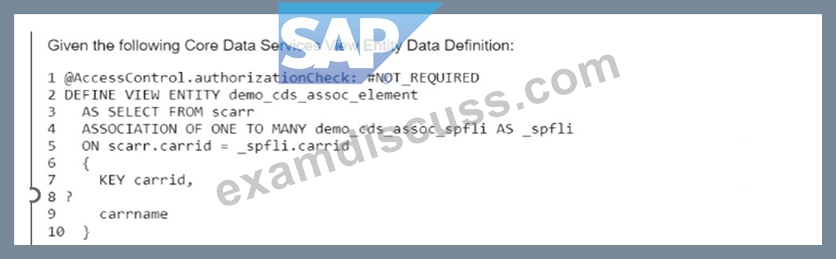
The "demo_ods_assoc_spfi data source referenced in line #4 contains a field "connid" which you would like to expose in the element list.
Which of the following statements would do this if inserted on line #8?
- A. demo_ods_assoc_spfli-connid/
- B. _spfli.connid/
- C. demo_ods_assoc_spfli.connid,
- D. spfli-connid,
Answer: C
Explanation:
The statement that can be used to expose the field "connid" of the data source "demo_ods_assoc_spfli" in the element list is A. demo_ods_assoc_spfli.connid,. This statement uses the dot notation to access the field
"connid" of the data source "demo_ods_assoc_spfli", which is an association defined on line #4. The association "demo_ods_assoc_spfli" links the data source "demo_ods" with the table "spfli" using the field
"carrid". The statement also ends with a comma to separate it from the next element in the list12.
You cannot do any of the following:
* B. demo_ods_assoc_spfli-connid/: This statement uses the wrong syntax to access the field "connid" of the data source "demo_ods_assoc_spfli". The dash notation is used to access the components of a structure or a table, not the fields of a data source. The statement also ends with a slash, which is not a valid separator for the element list12.
* C. spfli-connid,: This statement uses the wrong data source name to access the field "connid". The data source name should be "demo_ods_assoc_spfli", not "spfli". The statement also uses the wrong syntax to access the field "connid", as explained above12.
* D. _spfli.connid/: This statement uses the wrong data source name and the wrong separator to access the field "connid". The data source name should be "demo_ods_assoc_spfli", not "_spfli". The statement also ends with a slash, which is not a valid separator for the element list12.
References: 1: ABAP CDS - SELECT, select_list - ABAP Keyword Documentation - SAP Online Help 2: ABAP CDS - SELECT, from - ABAP Keyword Documentation - SAP Online Help
NEW QUESTION # 50
Which of the following are features of Core Data Services? Note: There are 3 correct answers to this question.
- A. Annotations
- B. Delegation
- C. Structured Query Language (SQL)
- D. Inheritance
- E. Associations
Answer: A,C,E
Explanation:
Core Data Services (CDS) is a framework for defining and consuming semantically rich data models in SAP HANA. CDS supports various features that enhance the capabilities of SQL and enable developers to create data models that are optimized for performance, readability, and extensibility12. Some of the features of CDS are:
* Associations: Associations are a way of defining relationships between CDS entities, such as tables or views. Associations enable navigation and path expressions in CDS queries, which allow accessing data from related entities without explicit joins. Associations also support cardinality, referential constraints, and cascading options34.
* Annotations: Annotations are a way of adding metadata to CDS entities or their elements, such as fields or parameters. Annotations provide additional information or instructions for the CDS compiler, the database, or the consumers of the CDS views. Annotations can be used for various purposes, such as defining access control, UI rendering, OData exposure, or search capabilities5 .
* Structured Query Language (SQL): SQL is the standard language for querying and manipulating data in relational databases. CDS is based on SQL and extends it with additional features and syntax. CDS supports SQL features such as joins, aggregations, filters, expressions, functions, and subqueries. CDS also supports SQL Script, which is a scripting language for stored procedures and functions in SAP HANA .
You cannot do any of the following:
* Inheritance: Inheritance is not a feature of CDS. Inheritance is a concept in object-oriented programming that allows a class to inherit the properties and methods of another class. CDS does not support object-oriented programming or classes.
* Delegation: Delegation is not a feature of CDS. Delegation is a concept in object-oriented programming that allows an object to delegate some of its responsibilities to another object. CDS does not support object-oriented programming or objects.
References: 1: Core Data Services (CDS) | CAPire 2: Core Data Services [CDS] in SAP S/4 HANA | SAP Blogs 3: Associations in Core Data Services (CDS) | SAP Help Portal 4: [CDS DDL - Association - ABAP Keyword Documentation - SAP Online Help] 5: [Annotations in Core Data Services (CDS) | SAP Help Portal]: [CDS DDL - Annotation - ABAP Keyword Documentation - SAP Online Help] : [Structured Query Language (SQL) | SAP Help Portal] : [CDS DDL - SQL Features - ABAP Keyword Documentation - SAP Online Help] : [Object-Oriented Programming in ABAP | SAP Help Portal]
NEW QUESTION # 51
For what kind of applications would you consider using on-stack developer extensions? Note: There are 2 correct answers to this question.
- A. Applications that run separate from SAP S/4HANA
- B. Applications that access SAP S/4HANA data using complex SQL
- C. Applications that provide APIs for side by side SAP BTP apps
- D. Applications that integrate data from several different systems
Answer: B,C
Explanation:
On-stack developer extensibility is a type of extensibility that allows you to create development projects directly on the SAP S/4HANA Cloud technology stack. It gives you the opportunity to develop cloud-ready and upgrade-stable custom ABAP applications and services inside the SAP S/4HANA Cloud, public edition system. You can use the ABAP Development Tools in Eclipse to create and deploy your on-stack extensions. On-stack developer extensibility is suitable for the following kinds of applications:
Applications that provide APIs for side by side SAP BTP apps. On-stack developer extensibility allows you to create OData services or RESTful APIs based on CDS view entities or projection views. These services or APIs can expose SAP S/4HANA data and logic to other applications that run on the SAP Business Technology Platform (SAP BTP) or other platforms. This way, you can create a loosely coupled integration between your SAP S/4HANA system and your side by side SAP BTP apps.
Applications that access SAP S/4HANA data using complex SQL. On-stack developer extensibility allows you to use ABAP SQL to access SAP S/4HANA data using complex queries, such as joins, aggregations, filters, parameters, and code pushdown techniques. You can also use ABAP SQL to perform data manipulation operations, such as insert, update, delete, and upsert. This way, you can create applications that require advanced data processing and analysis on SAP S/4HANA data.
The other kinds of applications are not suitable for on-stack developer extensibility, as they have different requirements and challenges. These kinds of applications are:
Applications that integrate data from several different systems. On-stack developer extensibility is not meant for creating applications that integrate data from multiple sources, such as other SAP systems, third-party systems, or cloud services. This is because on-stack developer extensibility does not support remote access or data replication, and it may cause performance or security issues. For this kind of applications, you should use side by side extensibility, which allows you to create applications that run on the SAP BTP and communicate with the SAP S/4HANA system via public APIs or events.
Applications that run separate from SAP S/4HANA. On-stack developer extensibility is not meant for creating applications that run independently from the SAP S/4HANA system, such as standalone apps, microservices, or web apps. This is because on-stack developer extensibility requires a tight coupling with the SAP S/4HANA system, and it may limit the scalability, flexibility, and portability of the applications. For this kind of applications, you should use side by side extensibility, which allows you to create applications that run on the SAP BTP and leverage the cloud-native features and services of the platform.
NEW QUESTION # 52
Which extensibility type does SAP recommend you use to enhance the existing UI for an SAP Fiori app?
- A. Key user
- B. Classic
- C. Developer
- D. Side-by-side
Answer: C
Explanation:
Explanation
According to the SAP clean core extensibility and ABAP cloud topic, SAP recommends using developer extensibility to enhance the existing UI for an SAP Fiori app. Developer extensibility allows you to use the UI adaptation editor in SAP Web IDE to modify the UI layout, add or remove fields, and bind them to the data model. You can also use the SAPUI5 framework to create custom controls, views, and controllers. Developer extensibility is based on the in-app extensibility concept, which means that the extensions are part of the same application and are deployed together with the app. Developer extensibility requires developer skills and access to the source code of the app. References: SAP Learning Hub, SAP S/4HANA Cloud Extensibility - In-App Extensibility, SAP Fiori: Extensibility
NEW QUESTION # 53
What are some properties of database tables? Note: There are 2 correct answers to this question.
- A. They can have any number of key fields.
- B. They may have key fields.
- C. They can have relationships to other tables.
- D. They store information in two dimensions.
Answer: C,D
Explanation:
Database tables are data structures that store information in two dimensions, using rows and columns. Each row represents a record or an entity, and each column represents an attribute or a field. Database tables may have key fields, which are columns that uniquely identify each row or a subset of rows. Key fields can be used to enforce data integrity, perform efficient searches, and establish relationships to other tables. Database tables can have relationships to other tables, which are associations or links between the key fields of two or more tables. Relationships can be used to model the logical connections between different entities, join data from multiple tables, and enforce referential integrity12.
NEW QUESTION # 54
What are some of the reasons that Core Data Services are preferable to the classical approach to data modeling? Note: There are 2 correct answers to this question.
- A. They avoid data transfer completely.
- B. They implement code pushdown.
- C. They compute results on the application server.
- D. They transfer computational results to the application server.
Answer: B,D
Explanation:
Explanation
Core Data Services (CDS) are preferable to the classical approach to data modeling for several reasons, but two of them are:
They implement code pushdown. Code pushdown is the principle of moving data-intensive logic from the application server to the database server, where the data resides. This reduces the data transfer between the application server and the database server, which improves the performance and scalability of the application. CDS enable code pushdown by allowing the definition of semantic data models and business logic in the database layer, using SQL and SQL-based expressions1.
They transfer computational results to the application server. CDS allow the application server to access the data and the logic defined in the database layer by using Open SQL statements. Open SQL is a standardized and simplified subset of SQL that can be used across different database platforms. Open SQL statements are translated into native SQL statements by the ABAP runtime environment and executed on the database server. The results of the computation are then transferred to the application server, where they can be further processed or displayed2.
References: 1: ABAP - Core Data Services (ABAP CDS) - ABAP Keyword Documentation 2: Open SQL - ABAP Keyword Documentation
NEW QUESTION # 55
In ABAP SQL, which of the following retrieves the association field_Airline-Name of a CDS view?
- A. @_Airline-Name
- B. "_Airline Name
- C. \_Airline-Name
- D. /_Airline Name
Answer: A
Explanation:
In ABAP SQL, the syntax to retrieve the association field of a CDS view is to use the @ sign followed by the association name and the field name, separated by a period sign (.). For example, to retrieve the association field _Airline-Name of a CDS view, the syntax is @_Airline.Name. This syntax allows the access to the fields of the target data source of the association without explicitly joining the data sources1. The other options are incorrect because they use the wrong symbols or formats to access the association field.
NEW QUESTION # 56
In class ZCL_CLASS_A, you use the statement DATA var TYPE ***
What may stand in place of ***? Note: There are 2 correct answers to this question.
- A. The name of a data element from the ABAP Dictionary
- B. The name of a type defined privately in class ZCL_CLASS_A
- C. The name of a type defined privately in another class
- D. The name of a domain from the ABAP Dictionary
Answer: A,D
Explanation:
Explanation
In class ZCL_CLASS_A, you use the statement DATA var TYPE *** to declare a data object named var with a data type specified by ***. The data type can be any of the following1:
A predefined ABAP type, such as i, f, c, string, xstring, and so on.
A data element from the ABAP Dictionary, such as matnr, carrid, bukrs, and so on. A data element defines the semantic and technical attributes of a data field, such as the domain, the length, the data type, the description, and the value range2.
A domain from the ABAP Dictionary, such as matnr_d, carrid_d, bukrs_d, and so on. A domain defines the technical attributes of a data field, such as the data type, the length, the output length, the number of decimal places, and the value range3.
A type defined globally in a class, an interface, or a type pool, such as zcl_class_b=>type_a, zif_interface_c=>type_b, ztype_pool_d=>type_c, and so on. A global type is a type that is defined in a global repository object and can be used in any program or class4.
A type defined locally in the current class, such as type_a, type_b, type_c, and so on. A local type is a type that is defined in the declaration part of a class and can only be used within the class5.
Therefore, the possible values for *** are B. the name of a data element from the ABAP Dictionary and D. the name of a domain from the ABAP Dictionary. The other options are not valid because:
A). The name of a type defined privately in class ZCL_CLASS_A is a local type and cannot be used with the DATA statement. A local type can only be used with the TYPES statement5.
C). The name of a type defined privately in another class is a private type and cannot be accessed from outside the class. A private type can only be used within the class that defines it.
References: 1: DATA - ABAP Keyword Documentation 2: Data Elements - ABAP Dictionary - SAP Online Help 3: Domains - ABAP Dictionary - SAP Online Help 4: Global Types - ABAP Keyword Documentation 5:
Local Types - ABAP Keyword Documentation : Private Types - ABAP Keyword Documentation
NEW QUESTION # 57
In RESTful Application Programming, a business object contains which parts? Note: There are 2 correct answers to this question.
- A. Behavior definition
- B. Authentication rules
- C. CDS view
- D. Process definition
Answer: A,C
Explanation:
In RESTful Application Programming, a business object contains two main parts: a CDS view and a behavior definition1.
A) CDS view: A CDS view is a data definition that defines the structure and the data source of a business object. A CDS view can consist of one or more entities that are linked by associations or compositions. An entity is a CDS view element that represents a node or a projection of a business object. An entity can have various annotations that define the metadata and the semantics of the business object2.
B) Behavior definition: A behavior definition is a source code artifact that defines the behavior and the validation rules of a business object. A behavior definition can specify the standard CRUD (create, read, update, delete) operations, the draft handling, the authorization checks, and the side effects for a business object. A behavior definition can also define custom actions, validations, and determinations that implement the business logic of a business object3.
The following are not parts of a business object in RESTful Application Programming, because:
C) Authentication rules: Authentication rules are not part of a business object, but part of a service binding. A service binding is a configuration artifact that defines how a business object is exposed as an OData service. A service binding can specify the authentication method, the authorization scope, the protocol version, and the service options for the OData service4.
D) Process definition: Process definition is not part of a business object, but part of a workflow. A workflow is a business process that orchestrates the tasks and the events of a business object. A workflow can be defined using the Workflow Editor in the SAP Business Application Studio or the SAP Web IDE. A workflow can use the business object's APIs to trigger or consume events, execute actions, or read or update data5.
NEW QUESTION # 58
Refer to the Exhibit.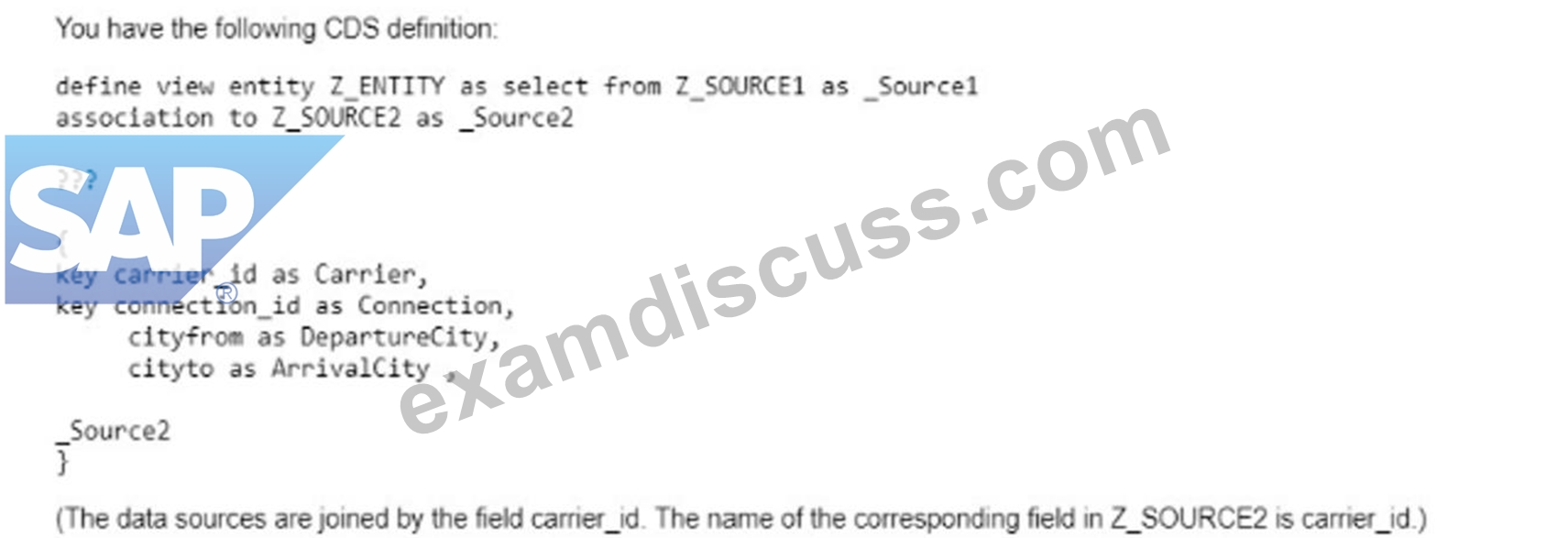
Which of the following ON conditions must you insert in place of "???"?
- A. ON Sprojection.carrier_id=Z_Source2.carrier_id
- B. ON Z_Sourcel.camer_id = 7_Source2 carrier_id
- C. ON Sprojection Camer=Source2 carrier_id
- D. ON Sprojection. Carrier Source2.carrier
Answer: A
Explanation:
The correct ON condition that must be inserted in place of "???" is:
ON Sprojection.carrier_id=Z_Source2.carrier_id
This ON condition specifies the join condition between the CDS view Sprojection and the database table Z_Source2. The join condition is based on the field carrier_id, which is the primary key of both the CDS view and the database table. The ON condition ensures that only the records that have the same value for the carrier_id field are joined together1.
The other options are not valid ON conditions, because:
A) ON Z_Sourcel.camer_id = 7_Source2 carrier_id is not valid because Z_Sourcel and 7_Source2 are not valid data sources in the given code. There is no CDS view or database table named Z_Sourcel or 7_Source2. The correct names are Z_Source1 and Z_Source2. Moreover, the field camer_id is not a valid field in the given code. There is no field named camer_id in any of the data sources. The correct name is carrier_id.
B) ON Sprojection Camer=Source2 carrier_id is not valid because Sprojection and Source2 are not valid data sources in the given code. There is no CDS view or database table named Sprojection or Source2. The correct names are Sprojection and Z_Source2. Moreover, the field Camer is not a valid field in the given code. There is no field named Camer in any of the data sources. The correct name is carrier_id. Furthermore, the ON condition is missing the dot (.) operator between the data source name and the field name, which is required to access the fields of the data source1.
C) ON Sprojection. Carrier Source2.carrier is not valid because Carrier and carrier are not valid fields in the given code. There is no field named Carrier or carrier in any of the data sources. The correct name is carrier_id. Moreover, the ON condition is missing the dot (.) operator between the data source name and the field name, which is required to access the fields of the data source1.
NEW QUESTION # 59
Which of the following integration frameworks have been released for ABAP cloud development? Note:
There are 3 correct answers to this question.
- A. OData services
- B. CDS Views
- C. Business Add-ins (BAdls)
- D. Business Events
- E. SOAP consumption
Answer: A,D,E
Explanation:
Explanation
The following are the integration frameworks that have been released for ABAP cloud development:
SOAP consumption: This framework allows you to consume SOAP web services from ABAP cloud applications. You can use the ABAP Development Tools in Eclipse to create a service consumption model based on a WSDL file or URL. The service consumption model generates the required ABAP artifacts, such as proxy classes, data types, and constants, to access the web service. You can then use the proxy classes to call the web service operations from your ABAP code1 Business Events: This framework allows you to publish and subscribe to business events from ABAP cloud applications. Business events are messages that represent a change in the state of a business object or process. You can use the ABAP Development Tools in Eclipse to create a business event definition based on a CDS view entity or a projection view. The business event definition specifies the event key, the event payload, and the event metadata. You can then use the ABAP Messaging Channel (AMC) framework to publish and subscribe to business events using the AMC API2 OData services: This framework allows you to expose and consume OData services from ABAP cloud applications. OData is a standardized protocol for creating and consuming RESTful APIs. You can use the ABAP RESTful Application Programming Model (RAP) to create OData services based on CDS view entities or projection views. The RAP framework generates the required OData metadata and runtime artifacts, such as service definitions, service bindings, and service implementations. You can then use the SAP Gateway framework to register and activate your OData services. You can also use the ABAP Development Tools in Eclipse to consume OData services from other sources using the service consumption model3 The other integration frameworks are not released for ABAP cloud development, as they are either not supported or not recommended for cloud scenarios. These frameworks are:
CDS Views: CDS views are not an integration framework, but a data modeling framework. CDS views are used to define data models based on database tables or other CDS view entities. CDS views can have associations, aggregations, filters, parameters, and annotations. CDS views can also be used as the basis for other integration frameworks, such as OData services or business events4 Business Add-ins (BAdls): BAdls are not supported for ABAP cloud development, as they are part of the classic ABAP enhancement framework. BAdls are used to implement custom logic in predefined enhancement spots in the standard SAP code. BAdls are not compatible with the cloud strategy and the clean core paradigm, as they modify the SAP code and can cause upgrade and maintenance issues. For ABAP cloud development, SAP recommends using the key user extensibility tools or the side-by-side extensibility approach instead of BAdls.
References: Consuming SOAP Services - ABAP Keyword Documentation, Business Events - ABAP Keyword Documentation, OData Services - ABAP Keyword Documentation, CDS Data Model Views - ABAP Keyword Documentation, [Business Add-Ins (BAdIs) - ABAP Keyword Documentation]
NEW QUESTION # 60
Which type of legacy code does SAP recommend you eliminate when you review modifications as part of an SAP S/4HANA system conversion? Note: There are 2 correct answers to this question.
- A. Code that now is identical to a standard SAP object
- B. Code that has less than 10% usage according to usage statistics
- C. Code that can be redesigned as a key user extension
- D. Code that supports a critical business process
Answer: A,C
Explanation:
Explanation
SAP recommends that you eliminate the following types of legacy code when you review modifications as part of an SAP S/4HANA system conversion:
Code that now is identical to a standard SAP object. This type of code is redundant and unnecessary, as it does not provide any additional functionality or customization. It can also cause conflicts or errors during the system conversion, as the standard SAP object may have changed or been replaced in SAP S/4HANA. Therefore, you should delete this type of code and use the standard SAP object instead.
Code that can be redesigned as a key user extension. This type of code is usually related to UI or business logic adaptations that can be achieved using the in-app tools provided by SAP S/4HANA. By redesigning this type of code as a key user extension, you can simplify and standardize your code base, reduce maintenance efforts, and avoid compatibility issues during the system conversion. Therefore, you should migrate this type of code to the key user extensibility framework and delete the original code.
The other types of legacy code are not recommended to be eliminated, as they may still be relevant or necessary for your business processes. However, you should still review and adjust them according to the SAP S/4HANA simplification items and best practices. These types of code are:
Code that supports a critical business process. This type of code is essential for your business operations and cannot be easily replaced or removed. However, you should check if this type of code is compatible with SAP S/4HANA, and if not, you should adapt it accordingly. You should also consider if this type of code can be optimized or enhanced using the new features and capabilities of SAP S/4HANA.
Code that has less than 10% usage according to usage statistics. This type of code is rarely used and may not be worth maintaining or converting. However, you should not delete this type of code without verifying its relevance and impact on your business processes. You should also consider if this type of code can be replaced or consolidated with other code that has higher usage or better performance.
References: Custom Code Management (CCM) During an SAP S/4HANA Conversion, Custom Code Migration Guide for SAP S/4HANA 2020
NEW QUESTION # 61
You are given the following information:
1.
The data source "spfli" on line #2 is an SAP HANA
database table
2.
"spfli" will be a large table with over one million rows.
3.
This program is the only one in the system that accesses
the table.
4.
This program will run rarely.
Based on this information, which of the following general
settings should you set for the spfli database table? Note:
There are 2 correct answers to this question.
- A. "Load Unit to "Column Loadable"
- B. "Storage Type" to "Row Store"
- C. "Load Unit' to 'Page Loadable"
- D. "Storage Type" to "Column Store"
Answer: B,C
Explanation:
Based on the given information, the spfli database table should have the following general settings:
"Storage Type" to "Row Store": This setting determines how the data is stored in the SAP HANA database. Row store is suitable for tables that are accessed by primary key or by a small number of columns. Column store is suitable for tables that are accessed by a large number of columns or by complex analytical queries. Since the spfli table is a large table with over one million rows, and this program is the only one in the system that accesses the table, it is likely that the program will use primary key access or simple queries to access the table. Therefore, row store is a better choice than column store for this table12.
"Load Unit" to "Page Loadable": This setting determines how the data is loaded into the memory when the table is accessed. Page loadable means that the data is loaded in pages of 16 KB each, and only the pages that are needed are loaded. Column loadable means that the data is loaded in columns, and only the columns that are needed are loaded. Since the spfli table is a row store table, and this program will run rarely, it is more efficient to use page loadable than column loadable for this table. Page loadable will reduce the memory consumption and the loading time of the table13.
NEW QUESTION # 62
Class super has subclass sub. Which rules are valid for the sub constructor? Note: There are 2 correct answers to this question.
- A. The constructor of super must be called before using any components of your own instance.
- B. Events of your own instance cannot be raised before the registration of a handler in super.
- C. The method signature can be changed.
- D. Import parameters can only be evaluated after calling the constructor of super.
Answer: A,C
Explanation:
The sub constructor is the instance constructor of the subclass sub that inherits from the superclass super. The sub constructor has some rules that it must follow when it is defined and implemented12. Some of the valid rules are:
* The method signature can be changed: This is true. The sub constructor can have a different method signature than the super constructor, which means that it can have different input parameters, output parameters, or exceptions. However, the sub constructor must still call the super constructor with appropriate actual parameters that match its interface12.
* The constructor of super must be called before using any components of your own instance: This is true.
The sub constructor must ensure that the super constructor is called explicitly using super->constructor before accessing any instance components of its own class, such as attributes or methods. This is because the super constructor initializes the inherited components of the subclass and sets the self-reference me-> to the current instance12.
You cannot do any of the following:
* Import parameters can only be evaluated after calling the constructor of super: This is false. The sub constructor can evaluate its own import parameters before calling the constructor of super, as long as it does not access any instance components of its own class. For example, the sub constructor can use its import parameters to calculate some values or check some conditions that are needed for calling the super constructor12.
* Events of your own instance cannot be raised before the registration of a handler in super: This is false.
* The sub constructor can raise events of its own instance before calling the constructor of super, as long as it does not access any instance components of its own class. For example, the sub constructor can raise an event to notify the consumers of the subclass about some status or error that occurred during the initialization of the subclass12.
References: 1: Inheritance and Constructors - ABAP Keyword Documentation - SAP Online Help 2: Using Static and Instance constructor methods | SAP Blogs
NEW QUESTION # 63
......
SAP C_ABAPD_2309 Exam Syllabus Topics:
| Topic | Details |
|---|---|
| Topic 1 |
|
| Topic 2 |
|
| Topic 3 |
|
| Topic 4 |
|
C_ABAPD_2309 Questions Truly Valid For Your SAP Exam: https://www.examdiscuss.com/SAP/exam/C_ABAPD_2309/
SAP Actual Free Exam Questions And Answers: https://drive.google.com/open?id=1a_t8U9rMMM1kLrI5GQhwGA_jvzYYmok3