

Python Institute PCPP-32-101 Exam Dumps [2024] Practice Valid Exam Dumps Question
PCPP-32-101 Dumps - Grab Out For [NEW-2024] Python Institute Exam
NEW QUESTION # 20
What will happen if the mamwindow is too small to fit all its widgets?
- A. The widgets will be scaled down to fit the window's size.
- B. The window will be expanded.
- C. An exception will be raised.
- D. Some widgets may be invisible
Answer: D
Explanation:
Explanation
If the main window is too small to fit all its widgets, some widgets may be invisible. So, the correct answer is Option A.
When a window is not large enough to display all of its content, some widgets may be partially or completely hidden. The window will not automatically expand to fit all of its content, and no exception will be raised. The widgets will not be automatically scaled down to fit the window's size.
If the main window is too small to fit all its widgets, some of the widgets may not be visible or may be partially visible. This is because the main window has a fixed size, and if there are more widgets than can fit within that size, some of them will be outside the visible area of the window.
To avoid this issue, you can use layout managers such as grid, pack, or place to dynamically adjust the size and position of the widgets as the window changes size. This will ensure that all the widgets remain visible and properly arranged regardless of the size of the main window.
References:
* https://www.tkdocs.com/tutorial/widgets.html#managers
* https://www.geeksforgeeks.org/python-tkinter-widgets/
* https://anzeljg.github.io/rin2/book2/2405/docs/tkinter/introduction.html
NEW QUESTION # 21
If w is a correctly created main application window, which method would you use to foe both of the main window's dimensions?
- A. w. f ixdim ()
- B. w.makewindow ()
- C. w. resizable ()
- D. w. f ixshape ()
Answer: C
Explanation:
Explanation
w.resizable()
The resizable() method takes two Boolean arguments, width and height, that specify whether the main window can be resized in the corresponding directions. Passing False to both arguments makes the main window non-resizable, whereas passing True to both arguments (or omitting them) makes the window resizable.
Here is an example that sets the dimensions of the main window to 500x400 pixels and makes it non-resizable:
importtkinter as tk
root = tk.Tk()
root.geometry("500x400")
root.resizable(False, False)
root.mainloop()
References:
* Tkinter documentation: https://docs.python.org/3/library/tk.html
* Tkinter tutorial: https://www.python-course.eu/python_tkinter.php
The resizable () method of a tkinter window object allows you to specify whether the window can be resized by the user in the horizontal and vertical directions. You can pass two boolean arguments to this method, such as w.resizable (False, False), to prevent both dimensions from being changed. Alternatively, you can pass 0 or
1 as arguments, such as w.resizable (0, 0), to achieve the same effect1.
References:
1: https://stackoverflow.com/questions/36575890/how-to-set-a-tkinter-window-to-a-constant-size Other methods that can be used to control the window size are:
* w.geometry () : This method allows you to set the initial size and position of the window by passing a string argument in the format "widthxheight+x+y", such as w.geometry ("500x500+100+100")12.
* w.minsize () and w.maxsize (): These methods allow you to set the minimum and maximum size of the window in pixels, such as w.minsize (500, 500) and w.maxsize (1000, 1000)12.
* w.pack_propagate () and w.grid_propagate (): These methods allow you to enable or disable the propagation of the size of the widgets inside the window to the window itself. By default, these methods are set to True, which means that the window will adjust its size according to the widgets it contains.
You can set these methods to False or 0 to prevent this behavior, such as w.pack_propagate (0) or w.grid_propagate (0).
* w.place (): This method allows you to place the window at a specific position and size relative to its parent window or screen. You can use keyword arguments such as x, y, width, height, relx, rely, relwidth, and relheight to specify the coordinates and dimensions of the window in absolute or relative terms, such as w.place (x=0, y=0, relwidth=1, relheight=1).
References:
2: https://stackoverflow.com/questions/25690423/set-window-dimensions-in-tkinter-python-3 :
https://stackoverflow.com/questions/36575890/how-to-set-a-tkinter-window-to-a-constant-size/36576068#36576
https://www.skotechlearn.com/2020/06/tkinter-window-position-size-center-screen-in-python.html
NEW QUESTION # 22
Select the true statement about PEP 8 recommendations related to line breaks and binary operators.
- A. It is recommended that you use line breaks before binary operators to improve code readability.
- B. It is permissible to use line breaks before or after a binary operator as long as the convention is consistent locally However, for new code it is recommended that break lines should be used only after binary operators.
- C. There is no specific PEP 8 recommendation related to using line breaks with binary operators.
- D. It is recommended that you use line breaks after binary operators to improve code readability.
Answer: A
Explanation:
Explanation
According to PEP 8, Python's official style guide, line breaks before binary operators produce more readable code, especially in code blocks with long expressions. This is stated in several sources (1,2,6,8) and is a widely accepted convention.
References:
* https://www.python.org/dev/peps/pep-0008/#should-a-line-break-before-or-after-a-binary-operator
* https://stackoverflow.com/questions/30614124/are-long-lines-broken-up-before-or-after-binary-operators-
* https://www.quora.com/What-is-PEP-8-Python
* https://www.techbeamers.com/python-tutorial-pep-8/
* https://www.section.io/engineering-education/python-coding-conventions-guidelines-for-python-programm
* https://towardsdatascience.com/a-step-in-pep8-style-guide-improving-the-readability-of-the-code-8114fd4
* https://www.codementor.io/@rishikeshdhokare/python-coding-style-best-practices-that-every-python-prog
* https://www.dataschool.io/python-pep8-tips-and-tricks/
NEW QUESTION # 23
Select the true statements about the sqirte3 module. (Select two answers.)
- A. The special name memory is used to create a database in RAM.
- B. The sqlite3 module provides an interface compliant with the DB-API 2.0.
- C. The sqhte3 module does not support transactions.
- D. The fetchall method returns an empty list when no rows are available
Answer: A,B
Explanation:
Explanation
The sqlite3 module in python provides an interface compliant to the DB-API 2.0. Thus, it follows a standard performance metric that allows for consistency in database programming with python.
The special name 'memory' is used to create a database in RAM using the sqlite3 module. Thus, when you use it as the name of the database file while opening a connection, it creates a temporary database that exists only in memory.
NEW QUESTION # 24
Which of the following will set the button text's font to 12 point italics Anal? (Select two answers)
- A.

- B.

- C.

- D.

Answer: B,C
Explanation:
Explanation
Option B is correct because it sets the font option of the button to a tuple containing the font family ('Arial'), size (12), and style ('italic').
Option C is correct because it sets the font option of the button to a string containing the font family ('Arial'), size (12), and style ('italic') separated by spaces.
NEW QUESTION # 25
Which of the following constants will be used if you do riot define the quoting argument in the writer method provided by the csv module?
- A. csv.QUOTE_NONNUMERIC
- B. csv.QUOTE_NONE
- C. csv.QUOTE_MINIMAL
- D. svQUOTE_ALL
Answer: C
Explanation:
Explanation
If you do not define the quoting argument in the writer method provided by the csv module, the default quoting behavior is set to QUOTE_MINIMAL. This means that fields containing special characters such as the delimiter or newline character will be quoted, while fields that do not contain special characters will not be quoted.
NEW QUESTION # 26
Analyze the following snippet and decide whether the code is correct and/or which method should be distinguished as a class method.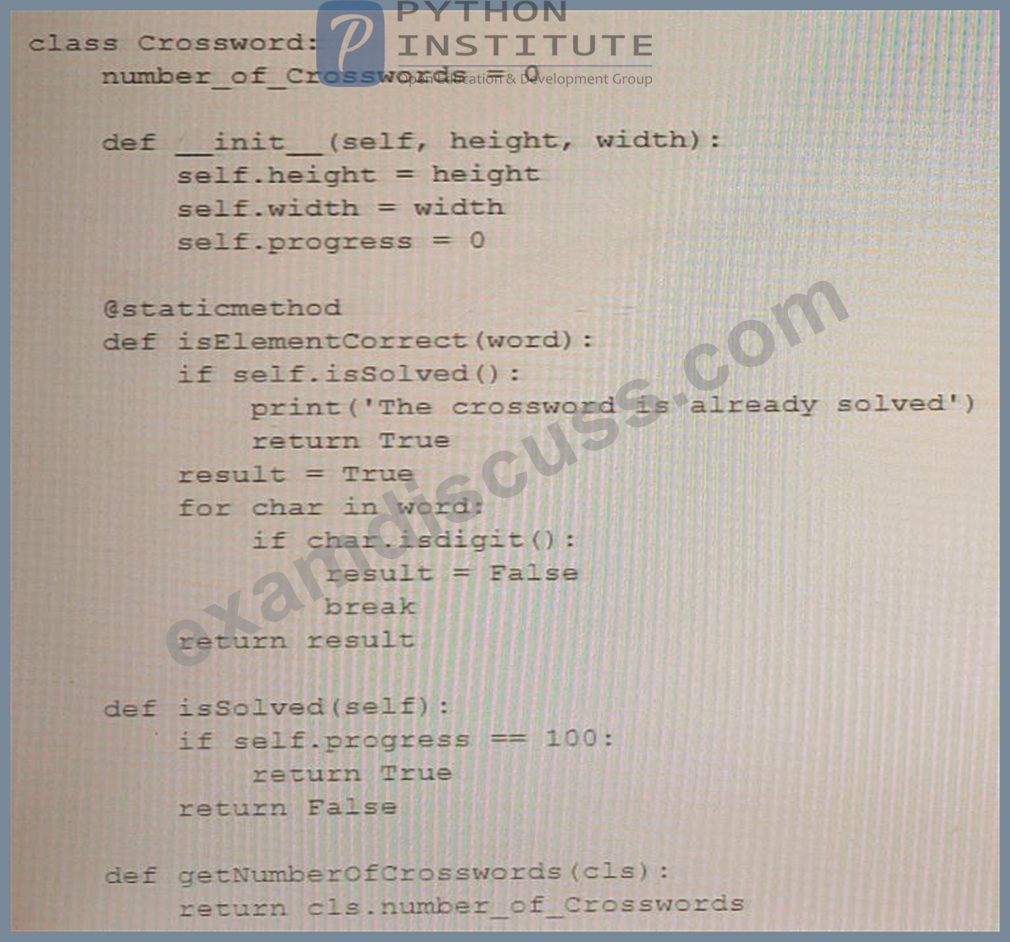
- A. The getNumberofCrosswords () method should be decorated With @classmethod.
- B. The code is erroneous.
- C. The gexNumberOfcrosswords () and issrived methods should be decorated with @classzoechod.
- D. There is only one initializer, so there is no need for a class method.
Answer: A
Explanation:
Explanation
The correct answer is B. The getNumberofCrosswords() method should be decorated with @classmethod. In the given code snippet, the getNumberofCrosswords method is intended to be a class method that returns the value of the numberofcrosswords class variable. However, the method is not decorated with the @classmethod decorator and does not take a cls parameter representing the class itself. To make getNumberofCrosswords a proper class method, it should be decorated with @classmethod and take a cls parameter as its first argument.
The getNumberofCrosswords() method should be decorated with @classmethod.
This is because the getNumberofCrosswords() method is intended to access the class-level variable numberofcrosswords, but it is defined as an instance method, which requires an instance of the class to be created before it can be called. To make it work as a class-level method, you can define it as a class method by adding the @classmethod decorator to the function.
Here's an example of how to define getNumberofCrosswords() as a class method:
classCrossword:
numberofcrosswords =0
def __init__(self, author, title):
self.author = author
self.title = title
Crossword.numberofcrosswords +=1
@classmethod
defgetNumberofCrosswords(cls):
returncls.numberofcrosswords
In this example, getNumberofCrosswords() is defined as a class method using the @classmethod decorator, and the cls parameter is used to access the class-level variable numberofcrosswords.
NEW QUESTION # 27
What is a static method?
- A. A method decorated with the @method trait
- B. A method that works on the class itself
- C. A method that works on class objects that are instantiated
- D. A method that requires no parameters referring to the class itself
Answer: D
Explanation:
Explanation
A static method is a method that belongs to a class rather than an instance of the class. It is defined using the @staticmethod decorator and does not take a self or cls parameter. Static methods are often used to define utility functions that do not depend on the state of an instance or the class itself.
NEW QUESTION # 28
What is true about the unbind () method? (Select two answers.)
- A. It needs a widget's object as an argument
- B. It is invoked from within a widget's object
- C. It needs the event name as an argument
- D. It is invoked from within the events object
Answer: B,C
Explanation:
Explanation
Option B is true because the unbind() method is invoked from within a widget's object 1.
Option D is true because the unbind() method needs the event name as an argument 1.
The unbind() method in Tkinter is used to remove a binding between an event and a function. It can be invoked from within a widget's object when a binding is no longer needed. The method requires the event name as an argument to remove the binding for that specific event. For example:
button = tk.Button(root, text="Click me")
button.bind("<Button-1>", callback_function) # bind left mouse click event to callback_function button.unbind("<Button-1>") # remove the binding for the left mouse click event
NEW QUESTION # 29
Analyze the following snippet and choose the best statement that describes it.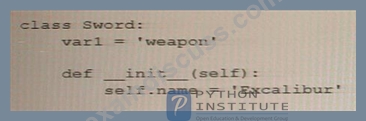
- A. Excalibur is the value passed to an instance variable
- B. Weapon is the value passed to an instance variable
- C. self. name is the name of a class variable.
- D. varl is the name of a global variable
Answer: A
Explanation:
Explanation
The correct answer is C. Excalibur is the value passed to an instance variable. In the given code snippet, self.name is an instance variable of the Sword class. When an instance of the Sword class is created with varl = Sword('Excalibur'), the value 'Excalibur' is passed as an argument to the __init__ method and assigned to the name instance variable of the varl object.
The code defines a class called Sword with an __init__ method that takes one parameter name. When a new instance of the Sword class is created with varl = Sword('Excalibur'), the value of the 'Excalibur' string is passed as an argument to the __init__ method, and assigned to the self.name instance variable of the varl object.
NEW QUESTION # 30
What is the result of the following code?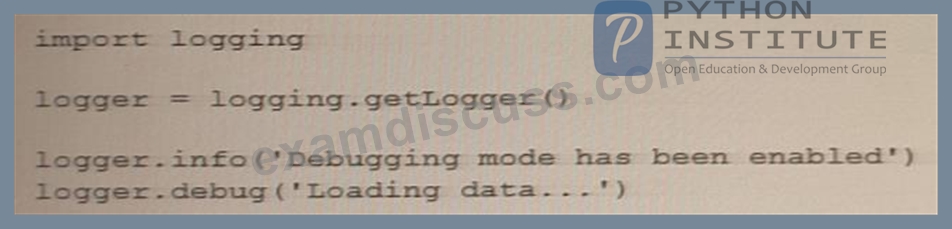
What is the result of the following code?
- A. Debugging mode has been enabled Loading data...
- B. Loading data...
- C. Debugging mode has been enabled
- D. Nothing will be displayed
Answer: B
Explanation:
Explanation
This statement is true because the code uses the logging module to create a logger object and set its level to logging.INFO. The logging module provides a way of reporting events that occur during the execution of a program. The logging level determines which events are reported and which are ignored. The logging module defines five levels of severity: DEBUG, INFO, WARNING, ERROR, and CRITICAL. The lower the level, the more events are reported.
The code then uses the logger object to log two messages: one with the level logging.DEBUG and one with the level logging.INFO. The logger object only reports the messages that have a level equal or higher than its own level. Therefore, the message with the level logging.DEBUG is ignored, while the message with the level logging.INFO is reported. The default format for reporting messages is "level name: message". Therefore, the output of the code is:
INFO: Loading data...
NEW QUESTION # 31
What is true about the unbind_all () method?
(Select two answers.)
- A. It is parameterless
- B. It causes all the widgets to disappear
- C. It can be invoked from the main window widget only
- D. It can be invoked from any widget
Answer: A,D
Explanation:
Explanation
The unbind_all() method in Tkinter is used to remove all event bindings from a widget. It is a method of the widget object and can be called on any widget in the Tkinter application. Therefore, option A is the correct answer.
Option B is incorrect because the method can be called on any widget, not just the main window widget.
Option C is correct as unbind_all() does not take any parameters.
Option D is incorrect because the method only removes event bindings and does not cause the widgets to disappear.
So, the correct answers are A and C.
References:
* Tkinter documentation: https://docs.python.org/3/library/tkinter.html#event-bindings
* Tkinter tutorial: https://www.python-course.eu/tkinter_events_binds.php
NEW QUESTION # 32
What isa___traceback___?
(Select two answers )
- A. A special method delivered by the traceback module to retrieve a full list of strings describing thetraceback
- B. An attribute owned by every exception object
- C. An attribute that is added to every object when the traceback module is imported
- D. An attribute that holds interesting information that is particularly useful when the programmer wants to store exception details in other objects
Answer: B,D
Explanation:
Explanation
The correct answers are A. An attribute owned by every exception object and D. An attribute that holds interesting information that is particularly useful when the programmer wants to store exception details in other objects. A traceback is an attribute of an exception object that contains a stack trace representing the call stack at the point where the exception was raised. The traceback attribute holds information about the sequence of function calls that led to the exception, which can be useful for debugging and error reporting.
NEW QUESTION # 33
Select the true statements about the connection-oriented and connectionless types of communication. (Select two answers.)
- A. Connectionless communications are usually built on top of TCP
- B. A phone call is an example of a connection-oriented communication
- C. Using walkie-talkies is an example of a connection-oriented communication
- D. In the context of TCP/IP networks, the communication side that initiates a connection is called the client, whereas the side that answers the client is called the server
Answer: B,D
Explanation:
Explanation
In the context of TCP/IP networks, the communication side that initiates a connection is called the client, whereas the side that answers the client is called the server.
This statement is true because TCP/IP networks use a client-server model to establish connection-oriented communications. The client is the device or application that requests a service or resource from another device or application, which is called the server. The server responds to the client's request and provides the service or resource.For example, when you browse a website using a web browser, the browser acts as a client and sends a request to the web server that hosts the website. The web server acts as a server and sends back the requested web page to the browser1.
Connectionless communications are usually built on top of TCP.
This statement is false because TCP (Transmission Control Protocol) is a connection-oriented protocol that requires establishing and terminating a connection before and after sending data. Connectionless communications are usually built on top of UDP (User Datagram Protocol), which is a connectionless protocol that does not require any connection setup or teardown. UDP simply sends data packets to the destination without checking if they are received or not2.
Using walkie-talkies is an example of a connection-oriented communication.
This statement is false because using walkie-talkies is an example of a connectionless communication.
Walkie-talkies do not establish a dedicated channel or connection between the sender and receiver before transmitting data. They simply broadcast data over a shared frequency without ensuring that the receiver is ready or available to receive it. The sender does not know if the receiver has received the data or not3.
A phone call is an example of a connection-oriented communication.
This statement is true because a phone call is an example of a connection-oriented communication. A phone call requires setting up a circuit or connection between the caller and callee before exchanging voice data. The caller and callee can hear each other's voice and know if they are connected or not. The phone call also requires terminating the connection when the conversation is over4.
References:
1: https://www.techtarget.com/searchnetworking/definition/client-server 2:
https://www.javatpoint.com/connection-oriented-vs-connectionless-service 3:
https://en.wikipedia.org/wiki/Walkie-talkie 4: https://en.wikipedia.org/wiki/Telephone_call A is true because in the context of TCP/IP networks, the communication side that initiates a connection is called the client, and the side that answers the client is called the server. This is the basis for establishing a connection-oriented communication.
D is true because a phone call is an example of a connection-oriented communication. Like TCP/IP, a phone call establishes a connection between two devices (in this case, two phones) before communication can occur.
A is true because in the context of TCP/IP networks, the communication side that initiates a connection is called the client, and the side that answers the client is called the server. This is the basis for establishing a connection-oriented communication.
D is true because a phone call is an example of a connection-oriented communication. Like TCP/IP, a phone call establishes a connection between two devices (in this case, two phones) before communication can occur.
B is false because connectionless communications are usually built on top of UDP, not TCP. UDP is a connectionless protocol that does not establish a connection before sending data.
C is false because using walkie-talkies is an example of a connectionless communication. Walkie-talkies do not establish a connection before communication begins, and messages are simply broadcasted to all devices within range.
Here is a sample code in Python using the socket module to create a TCP server and client to demonstrate the connection-oriented communication:
Server-side code:
importsocket
HOST ='127.0.0.1'
PORT =8080
with socket.socket(socket.AF_INET, socket.SOCK_STREAM) as s:
s.bind((HOST, PORT))
s.listen()
conn, addr = s.accept()
with conn:
print('Connected by', addr)
whileTrue:
data = conn.recv(1024)
ifnotdata:
break
conn.sendall(data)
Client-side code:
importsocket
HOST ='127.0.0.1'
PORT =8080
with socket.socket(socket.AF_INET, socket.SOCK_STREAM) as s:
s.connect((HOST, PORT))
s.sendall(b'Hello, world')
data = s.recv(1024)
print('Received',repr(data))
The server listens for incoming connections on port 8080, and when a connection is established, it prints the address of the client that has connected. The server then continuously receives data from the client and sends it back to the client until the connection is closed.
The client establishes a connection with the server and sends the message "Hello, world" encoded as bytes. It then waits for a response from the server and prints the data it receives.
NEW QUESTION # 34
In the JSON processing context, the term serialization:
- A. names a process in which a JSON string is turned into Python data.
- B. refers to nothing, because there is no such thing as JSON serialization.
- C. names a process in which a JSON string is remodeled and transformed into a new JSON string
- D. names a process in which Python data is turned into a JSON string.
Answer: D
Explanation:
Explanation
In the JSON processing context, the term serialization: A. names a process in which Python data is turned into a JSON string.
Serialization refers to the process of converting a data object, such as a Python object, into a format that can be easily transferred over a network or stored in a file. In the case of JSON, serialization refers to converting Python data into a string representation using the JSON format. This string can be sent over a network or stored as a file, and later deserialized back into the original Python data object.
NEW QUESTION # 35
Which one of the following methods allows you to debug an XML tree in the xml.etree ELementTree module?
- A. dump
- B. parse
- C. log
- D. debug
Answer: A
Explanation:
Explanation
The dump() method in the xml.etree.ElementTree module allows you to output a debug representation of an XML tree to a file or standard output. This method is useful for analyzing the structure of the tree and tracking down errors.
NEW QUESTION # 36
What is true about type in the object-oriented programming sense?
- A. It is a built-in method that allows enumeration of composite objects
- B. It is the topmost type that any class can inherit from
- C. It is an object used to instantiate a class
- D. It is the bottommost type that any object can inherit from.
Answer: B
Explanation:
Explanation
In Python, type is the built-in metaclass that serves as the base class for all new-style classes. All new-style classes in Python, including built-in types like int and str, are instances of the type metaclass and inherit from it.
NEW QUESTION # 37
Analyze the following snippet and select the statement that best describes it.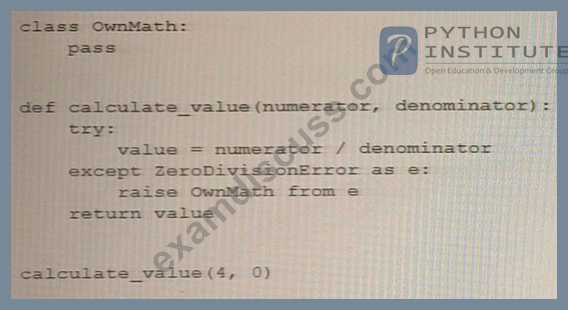
- A. The code is an example of implicitly chained exceptions.
- B. The code is erroneous as the OwnMath class does not inherit from any Exception type class
- C. The code is fine and the script execution is not interrupted by any exception.
- D. The code is an example of explicitly chained exceptions.
Answer: D
Explanation:
Explanation
In the given code snippet, an instance of OwnMath exception is raised with an explicitly specified __cause__ attribute that refers to the original exception (ZeroDivisionError). This is an example of explicitly chaining exceptions in Python.
NEW QUESTION # 38
......
The PCPP1 certification exam is administered by the Python Institute, a non-profit organization that promotes the use of Python programming language worldwide. The Python Institute has a network of authorized testing centers that offer the certification exam in over 100 countries. PCPP-32-101 exam is available in both online and offline formats, and candidates can choose the format that best suits their needs.
PCPP-32-101 Exam Dumps PDF Guaranteed Success with Accurate & Updated Questions: https://www.examdiscuss.com/Python-Institute/exam/PCPP-32-101/