

[Feb 28, 2025] Juniper JN0-649 Real Exam Questions and Answers FREE
Pass Juniper JN0-649 Exam Info and Free Practice Test
Earning the JNCIP-ENT certification not only validates a candidate’s expertise in enterprise routing and switching technologies but also demonstrates their commitment to professional development and career advancement. Enterprise Routing and Switching, Professional (JNCIP-ENT) certification can open up new career opportunities, increase earning potential, and provide a competitive edge in the job market.
The JNCIP-ENT exam covers topics such as advanced routing technologies, switch virtualization, Layer 2/Layer 3 protocols, and troubleshooting. Candidates are expected to have a deep understanding of the Junos OS, Juniper's flagship operating system. Passing JN0-649 exam demonstrates that a candidate has the necessary skills to plan, configure, and troubleshoot complex enterprise routing and switching solutions in a Juniper environment. It is a highly sought-after certification for networking professionals looking to advance their careers in the field of enterprise networking.
NEW QUESTION # 47
Referring to the exhibit, which two statements are correct? (Choose two.)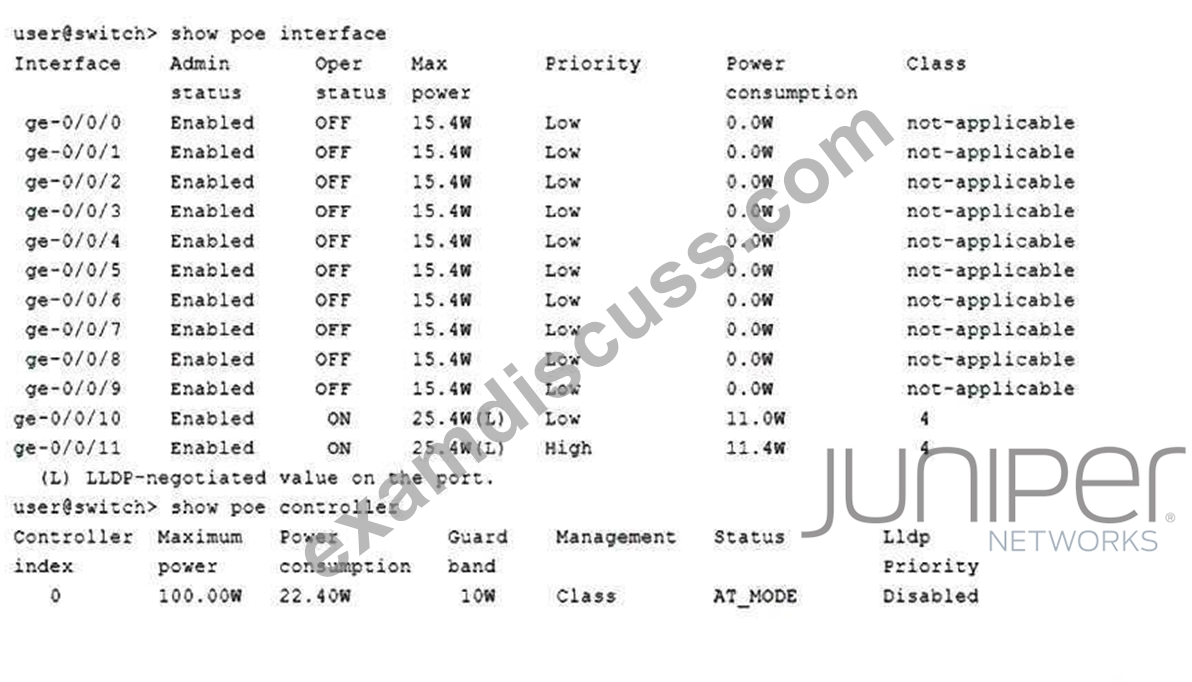
- A. If the total power consumption exceeds 90 watts, the ge-0/0/11 interface will continue to receive power.
- B. The maximum wattage that this switch can allocate to attached Ethernet devices is 100 watts.
- C. PoE is not enabled on the ge-0/0/0 interface.
- D. The ge-0/0/10 interface supports PoE+.
Answer: B,C
NEW QUESTION # 48
You are enabling MSTP in your Layer 2 network to prevent loops. In this scenario, which three parameters must match on all switches in the network? (Choose three. )
- A. revision level
- B. MSTI-to-VLAN mapping
- C. configuration name
- D. bridge priority
- E. max age
Answer: A,B,C
NEW QUESTION # 49
A BA classifier, input policer, and a multifield classifier are applied to an interface in which order are these features processed?
- A. BA classifier -> multifield classifier -> policer
- B. multifield classifier -> BA classifier -> policer
- C. policer > multifield classifier -> BA classifier
- D. policer -> BA classifier -> multifield classifier
Answer: D
NEW QUESTION # 50
Which three statements are correct about EVPN route types? (Choose three.)
- A. Type 3 routes carry replication information.
- B. Type 2 routes carry endpoint IP address information.
- C. Type 2 routes carry endpoint MAC address information.
- D. Type 1 routes carry endpoint MAC address information.
- E. Type 5 routes carry replication information.
Answer: A,B,C
Explanation:
Cisco explains it better: The EVPN control plane advertises the following types of information:
Route type 1 - This is an Ethernet Auto-Discovery (EAD) route type used to advertise Ethernet segment identifier, Ethernet Tag ID, and EVPN instance information. EAD route advertisements may be sent for each EVPN instance or for each Ethernet segment.
Route type 2 - This advertises endpoint reachability information, including MAC and IP addresses of the endpoints or VTEPs.
Route type 3 - This performs multicast router advertisement, announcing the capability and intention to use ingress replication for specific VNIs.
Route type 4 - This is an Ethernet Segment route used to advertise the Ethernet segment identifier, IP address length, and the originating router's IP address.
Route type 5 - This is an IP prefix route used to advertise internal IP subnet and externally learned routes to a VXLAN network.
NEW QUESTION # 51
When configuring connectivity to a VoIP enabled phone, which two statements are correct?
(Choose two.)
- A. The telephone device can signal to the switch which VLAN tag it will place on voice traffic.
- B. The switch places voice traffic in the expedited forwarding class by default.
- C. The switch places voice traffic in the best-effort forwarding class by default.
- D. The switch can signal to the phone device which VLAN tag it should use for voice traffic.
Answer: B,D
NEW QUESTION # 52
The connection between DC1 and DC2 is routed as shown in the exhibit.
In this scenario, which statement is correct?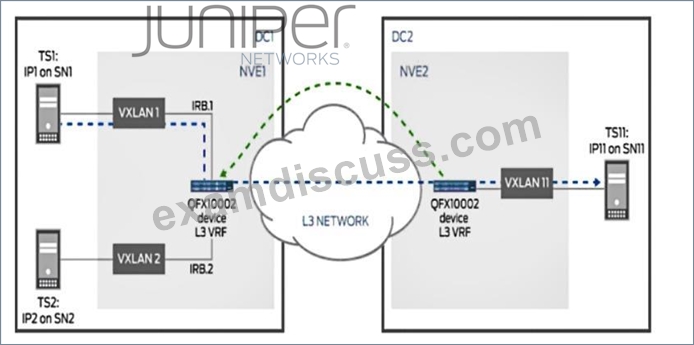
- A. The border devices must be able to perform Layer 3 routing and provide IRB functionality.
- B. L3VPN must be enabled to advertise reachability.
- C. An IP prefix route provides encoding for intra-subnet forwarding.
- D. Type 2 and Type 5 routes will be exchanged between DC1 and DC2.
Answer: A
Explanation:
https://www.juniper.net/documentation/us/en/software/junos/evpn-vxlan/topics/concept/evpn- route-type5-understanding.html
NEW QUESTION # 53
Referring to the exhibit, which two statements are correct? (Choose two.)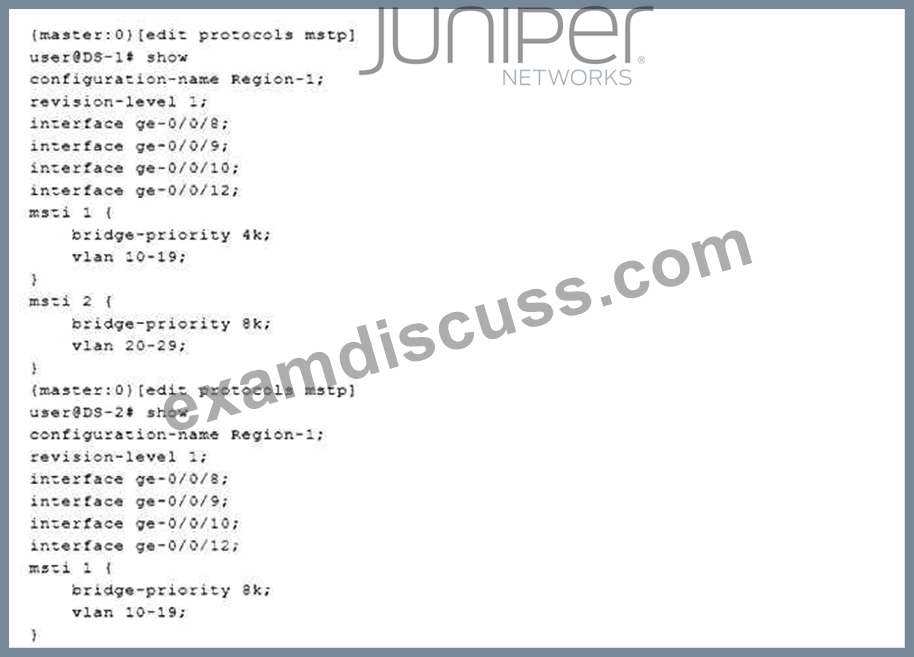
- A. The DS-1 switch will be root bridge for MSTI 2.
- B. The DS-1 switch will be root bridge for MSTI 1.
- C. The DS-2 switch will be root bridge for MSTI 1.
- D. The DS-2 switch will be root bridge for MSTI 2.
Answer: C,D
NEW QUESTION # 54
A modified deficit round-robin scheduler is defined by which three variables? (Choose three.)
- A. transmit rate
- B. Layer 3 fields
- C. priority
- D. WRED
- E. buffer size
Answer: A,C,D
NEW QUESTION # 55
You are 802.1X supplicant, but traffic must be accepted once the user has authenticated their computer on the port In this scenario, which supplicant mode should be used?
- A. multiple
- B. single-secure
- C. single
- D. captive-portal
Answer: C
NEW QUESTION # 56
You are deploying IP phones in your enterprise network that must receive their power through their Ethernet connection. You are using your EX Series switch's PoE ports that support IEEE
802.3af. In this scenario, what is the maximum amount of power allocated to each interface?
- A. 10.2 W
- B. 15.4 W
- C. 50 W
- D. 30 W
Answer: B
Explanation:
PoE was first defined in the IEEE 802.3af standard, which supplied up to 15.4 W of power to a connected powered device. Subsequent versions increased the amount of power that can be supplied to a powered device.
NEW QUESTION # 57
Referring to the exhibit, you have placed the cos multifield classifier on all edge interfaces and configured the relevant CoS parameters.
In this scenario, which two statements are correct? (Choose two.)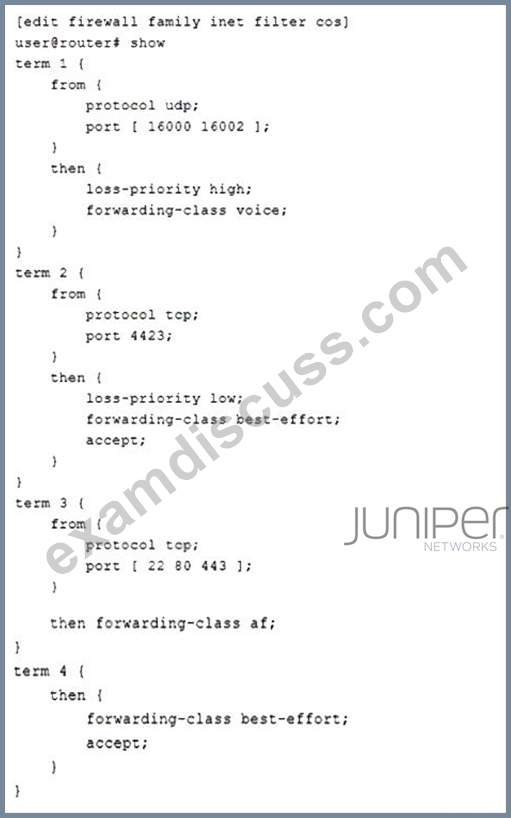
- A. UDP traffic using the 16000 port will be placed in the best-effort forwarding class and accepted.
- B. SSH traffic using the default port will be placed in the af forwarding class and accepted.
- C. SSH traffic using the default port will be placed in the best-effort forwarding class and accepted.
- D. UDP traffic using the 16000 port will be placed in the voice forwarding class and accepted.
Answer: B,D
NEW QUESTION # 58
You want to provide Layer 2 connectivity between campus sites using Ethernet switches through a metro Ethernet service provider who is using Q-in-Q tagging on their network.
Referring to the exhibit, what are two design considerations in this environment? (Choose two.)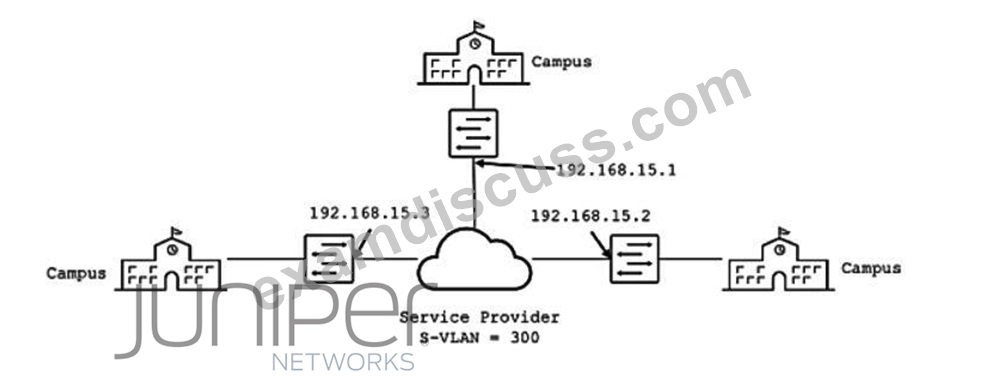
- A. Each campus switch shown must have S-Tag 300 configured.
- B. L2PT is required on the SP network to support the spanning tree protocol.
- C. VXLAN could be implemented on your network across this service provider network.
- D. Each campus switch shown must have a C-Tag 300 configured.
Answer: B,D
Explanation:
VXLAN , L2PT and S-Tag(service VLAN) are handled by ISP.
C-Tag (customer VLAN) is handled by customer. In fact, in customer view, 2 campus switches are direct connected to each others so that they have to configure same vlan info whatever it is trunk or access port.
NEW QUESTION # 59
You want to provide Layer 2 connectivity between campus sites using Ethernet switches through a metro Ethernet service provider who is using Q-in-Q tagging on their network.
Referring to the exhibit, what are two design considerations in this environment? (Choose two.)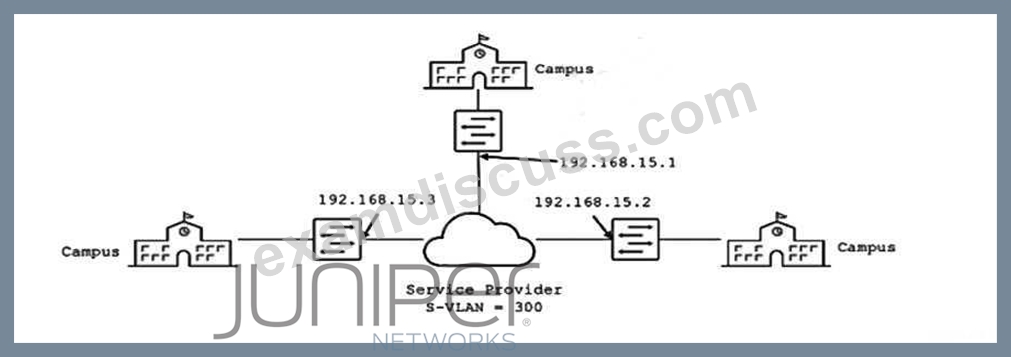
- A. Each campus switch shown must have S-Tag 300 configured.
- B. Each campus switch shown must have a C-Tag 300 configured.
- C. L2PT is required on the SP network to support the spanning tree protocol.
- D. VXLAN could be implemented on your network across this service provider network.
Answer: A,C
NEW QUESTION # 60
Refer to Exhibit: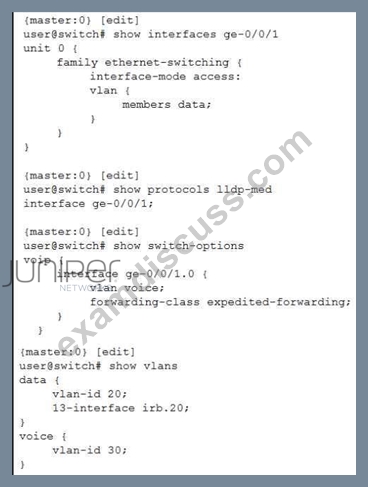
You have a workstation and a VoIP phone connected to port ge-0/0/1 on an access switch.
Referring to the exhibit, which two statements are true? (Choose two.)
- A. All frames that exit interface ge-0/0/1 will belong to the data VLAN.
- B. Voice frames that enter interface ge-0/0/1 will be forwarded as expedited forwarding traffic.
- C. Frames that exit interface ge-0/0/1 on the data VLAN will be tagged.
- D. The phone will automatically be assigned a VLAN ID.
Answer: B,D
Explanation:
https://www.juniper.net/documentation//en_US/junos/topics/topic-map/802-1x-and-voip-on- switches.html#id-example-setting-up-voip-with-8021x-and-lldp-med-on-an-ex-series-switch
https://www.juniper.net/documentation/en_US/junos/topics/topic-map/device-discovery-using-lldp- lldp-med.html
NEW QUESTION # 61
Your network has an unmanaged switch between the hosts and your EX Series switch. After the traffic enters the EX Series switch, each host must be on a separate VLAN.
How would you accomplish this task?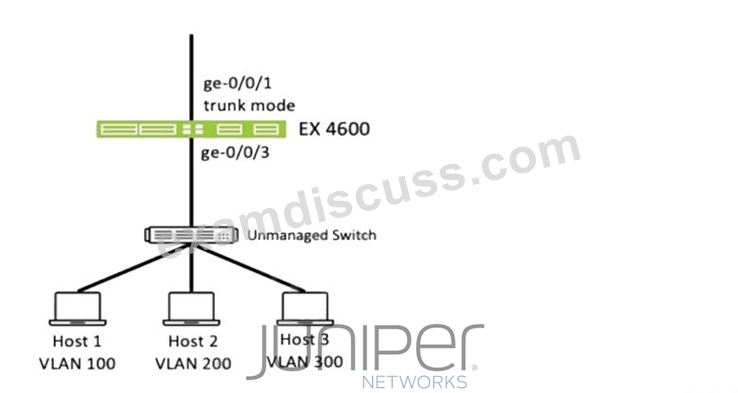
- A. Configure VSTP on interface ge-0/0/1 to assign the VLANs.
- B. Configure interface ge-0/0/3 to a mode trunk to assign the VLANs.
- C. Configure an input firewall filter on interface ge-0/0/3 to match the source MAC or IP address of the hosts to assign the VLANs.
- D. Configure an output firewall filter on interface ge-0/0/1 to match the destination MAC or IP address of the hosts to assign the VLANs.
Answer: B
NEW QUESTION # 62
Click the Exhibit.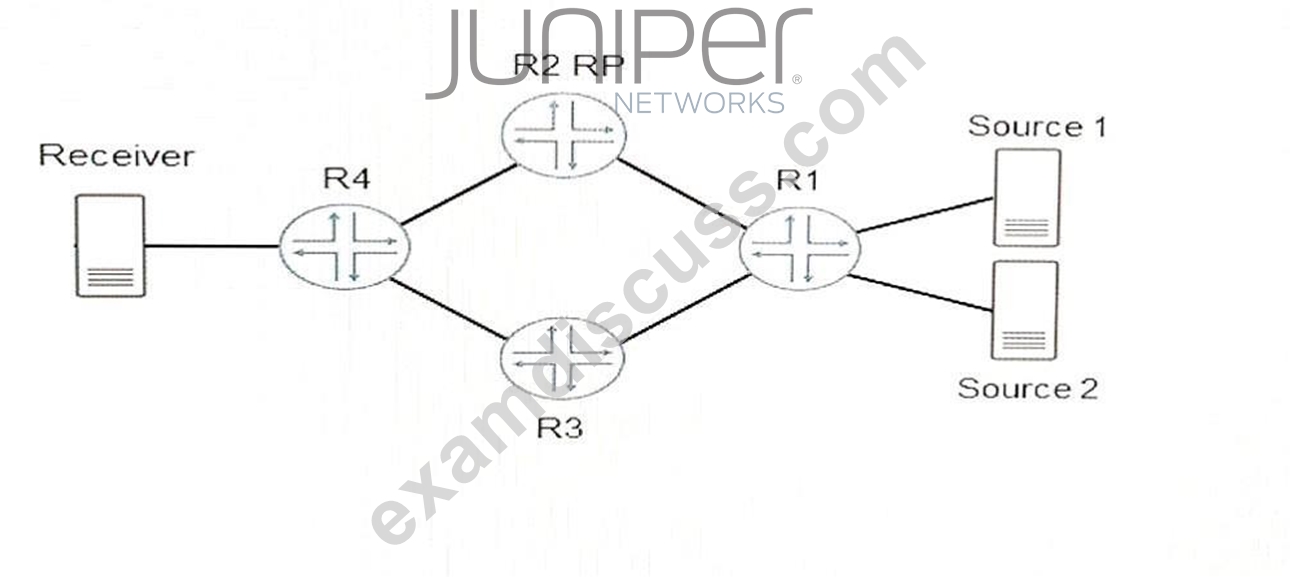
The Receiver is attempting to join two different groups, one from each source. You want to endure that load balancing is taking place.
Referring to the exhibit, which statement is true?
- A. R1 must have join-load-balance configured under protocol PIM.
- B. R3 must have join-load-balance configured under protocol PIM.
- C. R2 must have join-load-balance configured under protocol PIM.
- D. R4 must have join-load-balance configured under protocol PIM.
Answer: D
Explanation:
https://www.juniper.net/documentation/en_US/junos/topics/task/configuration/mcast-pim-join- load-balance.html
NEW QUESTION # 63
Referring to the exhibit, a RMSM network is set up to enable communication between multicast devices.
Which statement is true in this scenario?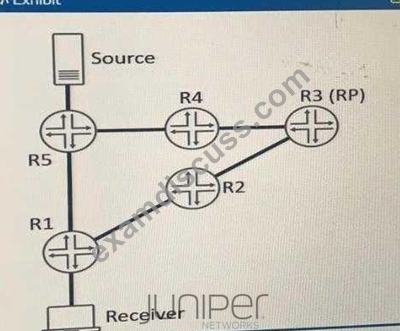
- A. After the formation of the shortest-path tree, a prune message is sent from R1 to R2.
- B. After the formation of the shortest-path tree, a join message is sent from R2 to R1.
- C. After the formation of the shortest-path tree, a join message is sent from R1 to R5
- D. After the formation of the shortest-path free, a prune message is sent from R1 to R5.
Answer: A
NEW QUESTION # 64
You are redistributing static routes into an OSPF area. Which two statement are true is this scenario? (Choose two.)
- A. The routes can be advertised in type LSAs.
- B. The external route advertisements have a domain scope.
- C. The area must be the backbone area.
- D. The area must be stub area.
Answer: A,C
NEW QUESTION # 65
Click the Exhibit button.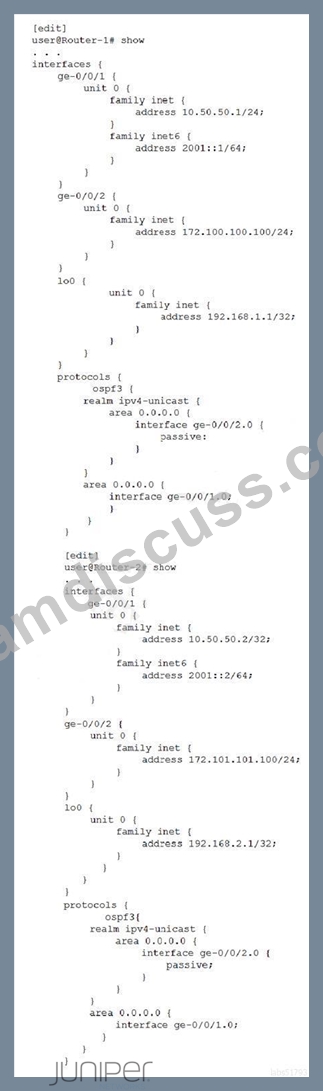
There is a functioning OSPFv3 neighborship between Router-1 and Router-2 over the ge-0/0/1 link. However, the 172.100.100.0/24 and 172.101.101.100/24 routes are not being shared through OSPFv3.
Referring to the configuration shown in the exhibit, which two actions must you take to solve the problem? (Choose two.)
- A. Add interface ge-0/0/1 under the IPv4 unicast realm for both routers.
- B. Add the IPv6 family protocol under ge-0/0/2 for both routers.
- C. Add interface ge-0/0/2 under OSPFv3 for both routers.
- D. Add the lo0 interface under OSPFv3 for both routers.
Answer: A,B
NEW QUESTION # 66
......
Latest JN0-649 Exam Dumps Juniper Exam: https://www.examdiscuss.com/Juniper/exam/JN0-649/
New 2025 Latest Questions JN0-649 Dumps - Use Updated Juniper Exam: https://drive.google.com/open?id=1uwndAvCDcQqA5kvJg5bDVJp3_Y2CoDdD