

ExamDiscuss HPE6-A78 Dumps PDF - 100% Passing Guarantee
HPE6-A78 Braindumps Real Exam Updated on Dec 17, 2024 with 110 Questions
NEW QUESTION # 14
What is social engineering?
- A. Hackers intercept traffic between two users, eavesdrop on their messages, and pretend to be one or both users.
- B. Hackers use employees to circumvent network security and gather the information they need to launch an attack.
- C. Hackers use Artificial Intelligence (Al) to mimic a user's online behavior so they can infiltrate a network and launch an attack.
- D. Hackers spoof the source IP address in their communications so they appear to be a legitimate user.
Answer: B
Explanation:
Social engineering in the context of network security refers to the techniques used by hackers to manipulate individuals into breaking normal security procedures and best practices to gain unauthorized access to systems, networks, or physical locations, or for financial gain. Hackers use various forms of deception to trick employees into handing over confidential or personal information that can be used for fraudulent purposes. This definition encompasses phishing attacks, pretexting, baiting, and other manipulative techniques designed to exploit human psychology. Unlike other hacking methods that rely on technical means, social engineering targets the human element of security. References to social engineering, its methods, and defense strategies are commonly found in security training manuals, cybersecurity awareness programs, and authoritative resources like those from the SANS Institute or cybersecurity agencies.
NEW QUESTION # 15
What is one difference between EAP-Tunneled Layer security (EAP-TLS) and Protected EAP (PEAP)?
- A. EAP-TLS creates a TLS tunnel for transmitting user credentials securely while PEAP protects user credentials with TKIP encryption.
- B. EAP-TLS begins with the establishment of a TLS tunnel, but PEAP does not use a TLS tunnel as part of Its process
- C. EAP-TLS requires the supplicant to authenticate with a certificate, hut PEAP allows the supplicant to use a username and password.
- D. EAP-TLS creates a TLS tunnel for transmitting user credentials, while PEAP authenticates the server and supplicant during a TLS handshake.
Answer: C
Explanation:
EAP-TLS and PEAP both provide secure authentication methods, but they differ in their requirements for client-side authentication. EAP-TLS requires both the client (supplicant) and the server to authenticate each other with certificates, thereby ensuring a very high level of security. On the other hand, PEAP requires a server-side certificate to create a secure tunnel and allows the client to authenticate using less stringent methods, such as a username and password, which are then protected by the tunnel. This makes PEAP more flexible in environments where client-side certificates are not feasible.References:
EAP-TLS and PEAP authentication protocols comparison.
NEW QUESTION # 16
What is a use case for tunneling traffic between an Aruba switch and an AruDa Mobility Controller (MC)?
- A. simplifying network infrastructure management by using the MC to push configurations to the switches
- B. applying firewall policies and deep packet inspection to wired clients
- C. enhancing the security of communications from the access layer to the core with data encryption
- D. securing the network infrastructure control plane by creating a virtual out-of-band-management network
Answer: D
Explanation:
Tunneling traffic between an Aruba switch and an Aruba Mobility Controller (MC) allows for the centralized application of firewall policies and deep packet inspection to wired clients. By directing traffic through the MC, network administrators can implement a consistent set of security policies across both wired and wireless segments of the network, enhancing overall network security posture.
NEW QUESTION # 17
What role does the Aruba ClearPass Device Insight Analyzer play in the Device Insight architecture?
- A. It resides on-prem and is responsible for running active SNMP and Nmap scans
- B. It resides In the cloud and applies machine learning and supervised crowdsourcing to metadata sent by Collectors
- C. It resides on-prem and provides the span port to which traffic is mirrored for deep analytics.
- D. It resides in the cloud and manages licensing and configuration for Collectors
Answer: B
Explanation:
The Aruba ClearPass Device Insight Analyzer plays a crucial role within the Device Insight architecture by residing in the cloud and applying machine learning and supervised crowdsourcing to the metadata sent by Collectors. This component of the architecture is responsible for analyzing vast amounts of data collected from the network to identify and classify devices accurately. By utilizing machine learning algorithms and crowdsourced input, the Device Insight Analyzer enhances the accuracy of device detection and classification, thereby improving the overall security and management of the network.
References:
Aruba ClearPass official documentation and whitepapers that detail the functionality and deployment of the Device Insight Analyzer.
Technical articles and presentations on network security solutions that discuss the use of machine learning and data analytics in device management.
NEW QUESTION # 18
Refer to the exhibit.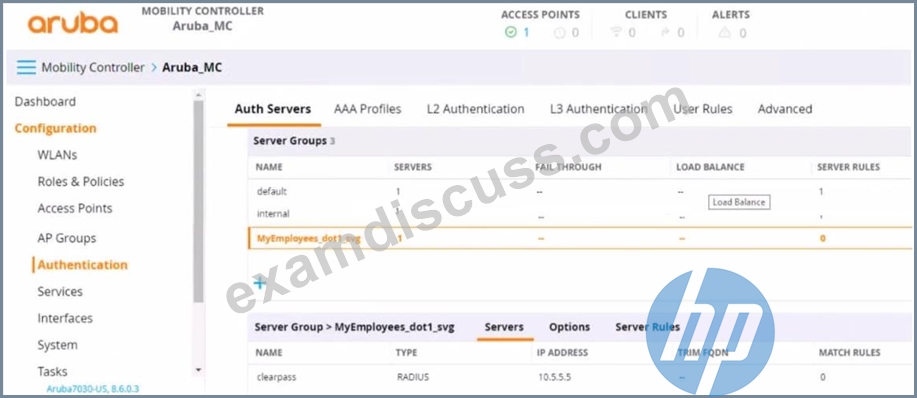
You have set up a RADIUS server on an ArubaOS Mobility Controller (MC) when you created a WLAN named "MyEmployees .You now want to enable the MC to accept change of authorization (CoA) messages from this server for wireless sessions on this WLAN.
What Is a part of the setup on the MC?
- A. Install the root CA associated with the 10 5.5.5 server's certificate as a Trusted CA certificate.
- B. Configure a ClearPass username and password in the MyEmployees AAA profile.
- C. Create a dynamic authorization, or RFC 3576, server with the 10.5.5.5 address and correct shared secret.
- D. Enable the dynamic authorization setting in the "clearpass" authentication server settings.
Answer: A
NEW QUESTION # 19
You have been instructed to look in the ArubaOS Security Dashboard's client list Your goal is to find clients mat belong to the company and have connected to devices that might belong to hackers Which client fits this description?
- A. MAC address d8:50:e6:f3;6e;60; Client Classification Interfering. AP Classification Interfering
- B. MAC address d8:50:e6:f3;6d;a4; Client Classification Authorized; AP Classification, interfering
- C. MAC address d8:50:e6 f3;6e;c5; Client Classification Interfering. AP Classification Neighbor
- D. MAC address d8:50:e6:f3;TO;ab; Client Classification Interfering. AP Classification Rogue
Answer: A
NEW QUESTION # 20
Your Aruba Mobility Master-based solution has detected a suspected rogue AP. Among other information, the ArubaOS Detected Radios page lists this information for the AP:
SSID = PublicWiFi
BSSID = a8:bd:27:12:34:56
Match method = Plus one
Match method = Eth-Wired-Mac-Table
The security team asks you to explain why this AP is classified as a rogue. What should you explain?
- A. The AP is probably connected to your LAN because it has a BSSID that is close to a MAC address that has been detected in your LAN. Because it does not belong to the company, it is a suspected rogue.
- B. The AP has a BSSID that is close to your authorized APs' BSSIDs. This indicates that the AP might be spoofing the corporate SSID and attempting to lure clients to it, making the AP a suspected rogue.
- C. The AP is an AP that belongs to your solution. However, the ArubaOS has detected that it is behaving suspiciously. It might have been compromised, so it is classified as a suspected rogue.
- D. The AP has been detected using multiple MAC addresses. This indicates that the AP is spoofing its MAC address, which qualifies it as a suspected rogue.
Answer: A
Explanation:
The Match method 'Eth-Wired-Mac-Table' suggests that the BSSID of the rogue AP has been found in the Ethernet (wired) MAC address table of the network infrastructure. This means the AP is physically connected to the LAN. If the BSSID does not match the company's authorized APs, it implies the AP is unauthorized and hence classified as a rogue.
NEW QUESTION # 21
What is one of the roles of the network access server (NAS) in the AAA framewonx?
- A. It enforces access to network services and sends accounting information to the AAA server
- B. It determines which resources authenticated users are allowed to access and monitors each users session
- C. It authenticates legitimate users and uses policies to determine which resources each user is allowed to access.
- D. It negotiates with each user's device to determine which EAP method is used for authentication
Answer: C
NEW QUESTION # 22
An ArubaOS-CX switch enforces 802.1X on a port. No fan-through options or port-access roles are configured on the port The 802 1X supplicant on a connected client has not yet completed authentication Which type of traffic does the authenticator accept from the client?
- A. DHCP, DNS and RADIUS only
- B. DHCP, DNS, and EAP only
- C. RADIUS only
- D. EAP only
Answer: D
Explanation:
For an ArubaOS-CX switch enforcing 802.1X on a port without any fallback options or port-access roles configured, and where the supplicant on the connected client has not completed authentication, the only type of traffic the authenticator accepts from the client is EAP (Extensible Authentication Protocol). EAP is a universal authentication framework used in 802.1X for message exchange during the authentication process.
The switch allows EAP packets because they are necessary for the client and the authentication server to perform the authentication process. This is standard behavior for 802.1X authenticators, which is to permit EAP traffic to pass through even before authentication is successful to facilitate the authentication exchange.
This information is supported by the IEEE 802.1X standard and ArubaOS-CX security configuration guides.
NEW QUESTION # 23
Refer to the exhibit.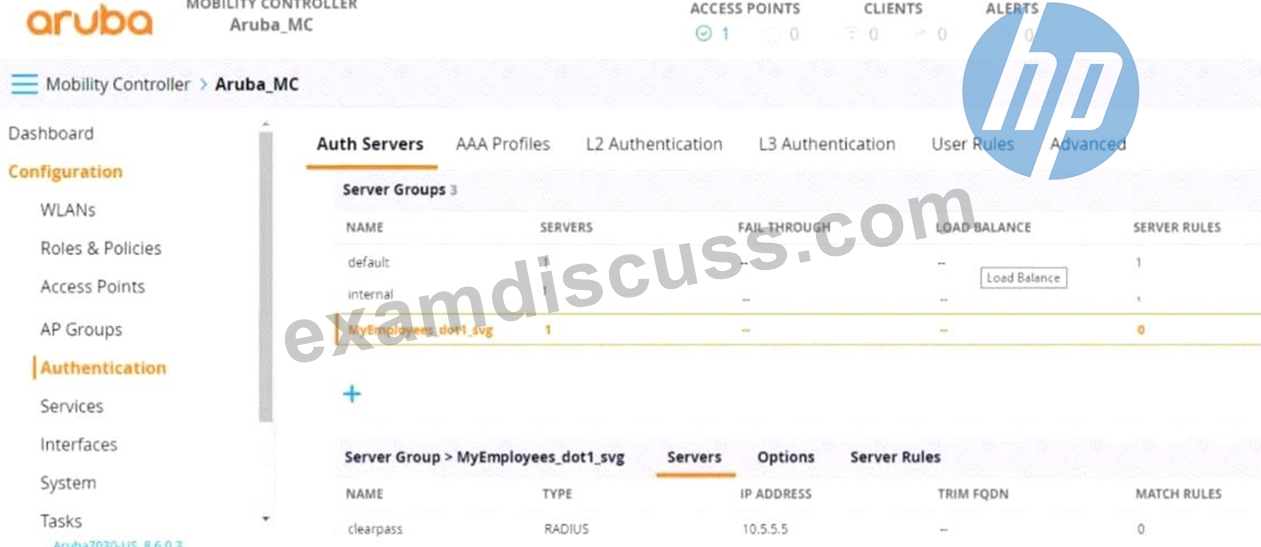
You have set up a RADIUS server on an ArubaOS Mobility Controller (MC) when you created a WLAN named "MyEmployees .You now want to enable the MC to accept change of authorization (CoA) messages from this server for wireless sessions on this WLAN.
What Is a part of the setup on the MC?
- A. Install the root CA associated with the 10 5.5.5 server's certificate as a Trusted CA certificate.
- B. Configure a ClearPass username and password in the MyEmployees AAA profile.
- C. Create a dynamic authorization, or RFC 3576, server with the 10.5.5.5 address and correct shared secret.
- D. Enable the dynamic authorization setting in the "clearpass" authentication server settings.
Answer: C
Explanation:
To enable an ArubaOS Mobility Controller (MC) to accept Change of Authorization (CoA) messages from a RADIUS server for wireless sessions on a WLAN, part of the setup on the MC involves creating a dynamic authorization, or RFC 3576, server with the provided IP address (10.5.5.5) and the correct shared secret. This setup allows the MC to handle CoA requests, which are used to change the authorization attributes of a session after it has been authenticated, such as disconnecting a user or changing a user's VLAN assignment.
NEW QUESTION # 24
What is a correct guideline for the management protocols that you should use on ArubaOS-Switches?
- A. Disable SSH and use https instead.
- B. Disable HTTPS and use SSH instead
- C. Disable Telnet and use SSH instead
- D. Disable Telnet and use TFTP instead.
Answer: A
NEW QUESTION # 25
A company has Aruba Mobility Controllers (MCs). Aruba campus APs. and ArubaOS-CX switches. The company plans to use ClearPass Policy Manager (CPPM) to classify endpoints by type The ClearPass admins tell you that they want to run Network scans as part of the solution What should you do to configure the infrastructure to support the scans?
- A. Create a TA profile on the ArubaOS-Switches with the root CA certificate for ClearPass's HTTPS certificate
- B. Create remote mirrors on the ArubaOS-Swrtches that collect traffic on edge ports, and mirror it to CPPM's IP address.
- C. Create SNMPv3 users on ArubaOS-CX switches, and make sure that the credentials match those configured on CPPM
- D. Create device fingerprinting profiles on the ArubaOS-Switches that include SNMP. and apply the profiles to edge ports
Answer: D
NEW QUESTION # 26
Which is a use case for enabling Control Plane Policing on Aruba switches?
- A. to encrypt traffic between tunneled node switches and Mobility Controllers (MCs)
- B. to mitigate Denial of Service (Dos) attacks on the switch
- C. to prevent the switch from accepting routing updates from unauthorized users
- D. to prevent unauthorized network devices from sending routing updates
Answer: B
Explanation:
Control Plane Policing (CoPP) on Aruba switches is used to mitigate Denial of Service (DoS) attacks on the switch. CoPP allows network administrators to restrict the impact of control plane traffic on the switch's CPU, thereby protecting network stability and integrity. By setting rate limits and specifying allowed traffic types, administrators can prevent malicious or malformed packets from overwhelming the switch's control plane, which could otherwise lead to a DoS condition and potentially disrupt network operations. This use case of CoPP is detailed in Aruba's network management documentation, where best practices and configurations to protect against DoS attacks are discussed.
NEW QUESTION # 27
You have deployed a new Aruba Mobility Controller (MC) and campus APs (CAPs). One of the WLANs enforces 802.IX authentication lo Aruba ClearPass Policy Manager {CPPM) When you test connecting the client to the WLAN. the test falls You check Aruba ClearPass Access Tracker and cannot find a record of the authentication attempt You ping from the MC to CPPM. and the ping is successful.
What is a good next step for troubleshooting?
- A. Renew CPPM's RADIUS/EAP certificate
- B. Check connectivity between CPPM and a backend directory server
- C. Check CPPM Event viewer.
- D. Reset the user credentials
Answer: C
Explanation:
When dealing with a failed 802.1X authentication attempt to a WLAN enforced by Aruba ClearPass Policy Manager (CPPM) where no record of the attempt is seen in ClearPass Access Tracker, a good next troubleshooting step is to check the CPPM Event Viewer. Since you are able to successfully ping from the Mobility Controller to CPPM, this indicates that there is network connectivity between these two devices.
The lack of a record in Access Tracker suggests that the issue may not be with the RADIUS/EAP certificate or user credentials, but possibly with the ClearPass service itself or its reception of authentication requests.
The Event Viewer can provide detailed logs that might reveal internal errors or misconfigurations within CPPM that could prevent it from processing authentication attempts properly.
NEW QUESTION # 28
Refer to the exhibit.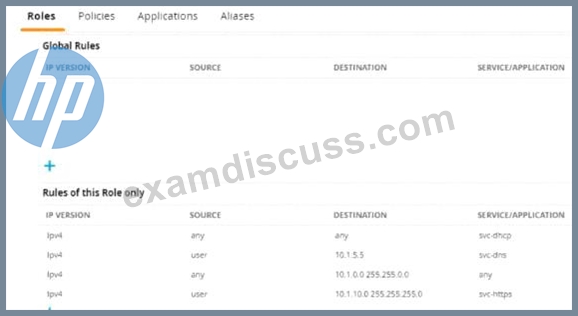
A diem is connected to an ArubaOS Mobility Controller. The exhibit snows all Tour firewall rules that apply to this diem What correctly describes how the controller treats HTTPS packets to these two IP addresses, both of which are on the other side of the firewall
10.1 10.10
203.0.13.5
- A. It permits the packet to 10.1.10.10 and drops the packet to 203 0.13.5
- B. It drops both of the packets
- C. it permits both of the packets
- D. It drops the packet to 10.1.10.10 and permits the packet to 203.0.13.5.
Answer: A
Explanation:
Referring to the exhibit, the ArubaOS Mobility Controller treats HTTPS packets based on the firewall rules applied to the client. The rule that allows svc-https service for destination IP range 10.1.0.0 255.255.0.0 would permit an HTTPS packet to 10.1.10.10 since this IP address falls within the specified range. There are no rules shown that would allow traffic to the IP address 203.0.13.5; hence, the packet to this address would be dropped.
References:
ArubaOS firewall configuration guides detailing how firewall rules are interpreted and applied to traffic.
Network security textbooks explaining firewall rule processing and packet filtering based on source and destination IP addresses.
NEW QUESTION # 29
Refer to the exhibit.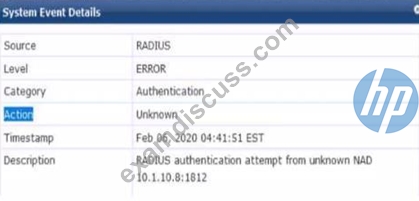
You are deploying a new ArubaOS Mobility Controller (MC), which is enforcing authentication to Aruba ClearPass Policy Manager (CPPM). The authentication is not working correctly, and you find the error shown In the exhibit in the CPPM Event Viewer.
What should you check?
- A. that the MC has been added as a domain machine on the Active Directory domain with which CPPM is synchronized
- B. that the IP address that the MC is using to reach CPPM matches the one defined for the device on CPPM
- C. that the snared secret configured for the CPPM authentication server matches the one defined for the device on CPPM
- D. that the MC has valid admin credentials configured on it for logging into the CPPM
Answer: B
NEW QUESTION # 30
You have an Aruba solution with multiple Mobility Controllers (MCs) and campus APs. You want to deploy a WPA3-Enterprise WLAN and authenticate users to Aruba ClearPass Policy Manager (CPPM) with EAP-TLS.
What is a guideline for ensuring a successful deployment?
- A. Deploy certificates to clients, signed by a CA that CPPM trusts.
- B. Avoid enabling CNSA mode on the WLAN, which requires the internal MC RADIUS server.
- C. Educate users in selecting strong passwords with at least 8 characters.
- D. Ensure that clients trust the root CA for the MCs' Server Certificates.
Answer: A
Explanation:
For WPA3-Enterprise with EAP-TLS, it's crucial that clients have a trusted certificate installed for the authentication process. EAP-TLS relies on a mutual exchange of certificates for authentication. Deploying client certificates signed by a CA that CPPM trusts ensures that the ClearPass Policy Manager can verify the authenticity of the client certificates during the TLS handshake process. Trust in the root CA is typically required for the server side of the authentication process, not the client side, which is covered by the client's own certificate.
NEW QUESTION # 31
You have an Aruba Mobility Controller (MC). for which you are already using Aruba ClearPass Policy Manager (CPPM) to authenticate access to the Web Ul with usernames and passwords You now want to enable managers to use certificates to log in to the Web Ul CPPM will continue to act as the external server to check the names in managers' certificates and tell the MC the managers' correct rote in addition to enabling certificate authentication. what is a step that you should complete on the MC?
- A. Verify that the MC trusts CPPM's HTTPS certificate by uploading a trusted CA certificate Also, configure a CPPM username and password on the MC
- B. Create a local admin account mat uses certificates in the account, specify the correct trusted CA certificate and external authentication
- C. Verify that the MC has the correct certificates, and add RadSec to the RADIUS server configuration for CPPM
- D. install all of the managers' certificates on the MC as OCSP Responder certificates
Answer: A
Explanation:
To enable managers to use certificates to log into the Web UI of an Aruba Mobility Controller (MC), where Aruba ClearPass Policy Manager (CPPM) acts as the external server for authentication, it is essential to ensure that the MC trusts the HTTPS certificate used by CPPM. This involves uploading a trusted CA certificate to the MC that matches the one used by CPPM. Additionally, configuring a username and password for CPPM on the MC might be necessary to secure and facilitate communication between the MC and CPPM. This setup ensures that certificate-based authentication is securely validated, maintaining secure access control for the Web UI.
References:
Aruba Mobility Controller configuration guides that detail the process of setting up certificate-based authentication.
Best practices for secure authentication and certificate management in enterprise network environments.
NEW QUESTION # 32
......
HPE6-A78 Dumps With 100% Verified Q&As - Pass Guarantee or Full Refund: https://www.examdiscuss.com/HP/exam/HPE6-A78/
Latest HPE6-A78 PDF Dumps & Real Tests Free Updated Today: https://drive.google.com/open?id=1YY-q6nYPffA85_fLNTVRQ3ZpHLXP1dnM