

Dec 15, 2025 Newest HPE7-A07 Exam Dumps – Achieve Success in Actual HPE7-A07 Exam
Updated HP HPE7-A07 Dumps – Check Free HPE7-A07 Exam Dumps (2025)
NEW QUESTION # 33
Your customer's employees connected to a wired network are complaining about a poor user experience. The customer has UXI sensors deployed on their premises. These sensors nave been running for multiple months.
They are testing both the wired network (using the wired Interface of each sensor) and the wireless networks.
Your customer used the UXI dashboard to find the reason for the poor userexperience to find more details, the customer asked you to check the packet captures that have been downloaded from the sensors using the UXI dashboard.
From the zip file downloaded from the UXI sensors, you checked the "datagrams" .pcap file, but you were not able to find any issues How can you explain this?
- A. The "datagrams- pcap file only contains me successful tests Failed tests are contained in the
"datagrams-failed" .pcap file - B. The datagrams captured on the physical Ethernet interface are in a different .pcap file.
- C. The UXI sensor could not upload the latest test results to the cloud, so the packet capture is outdated
- D. The default filers of the packet captures do not allow tailed tests to be captured by the sensor
Answer: A
Explanation:
It is a common practice to separate successful and failed test results into different files for ease of troubleshooting. If the "datagrams.pcap" file shows no issues, it's likely because it only contains successful test data, and the failed tests that could explain the poor user experience would be in a different file, such as
"datagrams-failed.pcap."
NEW QUESTION # 34
After onboarding three new AOS 10 gateways using the full-setup methodinto the same Central group, a customer cannot log in to one of the gateways using the HPE Aruba Networking Central remote console due to an incorrect password.
- A. The admin password created at the Central group level has expired
- B. The admin password created during the run-setup process is not configured to allow me remote console access
- C. The admin password created during the full-setup process does not match the Central group admin password
- D. The admin password created using full-setup does not match the global Central admin password.
Answer: C
Explanation:
When onboarding devices into a centralized management system, each device can have its individual admin password set during the onboarding process. If this password doesn't match what is expected at the group level in the central management platform, login issues such as the one described can occur.
NEW QUESTION # 35
A deployment using AP-635S is connectedto a stack of CX 6300s as shown.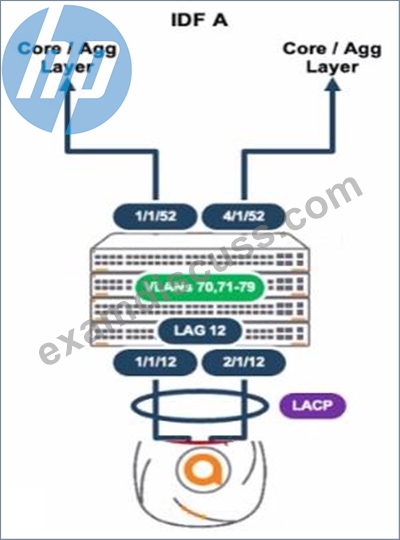
The output of the snow LACPinterfaces shews the following: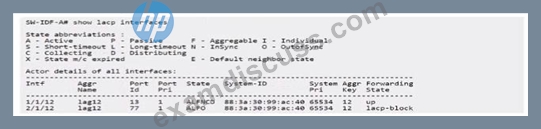
What is causing this issue?
- A. Each AP interface is connected to a routed-only interlace on different networks
- B. e0 is connected to a smart rate interface, and e1 is connected to a non-smart rate interface.
- C. Spanning tree and loop protect are enabled on both AP uplink ports.
- D. The AP is configured with LACP active
Answer: D
Explanation:
In an Aruba deployment, if an AP's interfaces show different LACP states, it often indicates a configuration mismatch. If one interface is up and the other is blocked as shown in the output,it's likely due to both interfaces on the AP being set to LACP active mode, which is a correct setting for establishing an LACP channel with Aruba switches like the CX 6300 series.
NEW QUESTION # 36
A customer's infrastructure is set up to use Doth primary and secondary gateway clusters on the SSID profile What is a valid reason for the AP to failover to the secondary gateway cluster?
- A. The secondary gateway cluster is homogeneous.
- B. The primary gateway cluster is up. out the AP is unable to reach the primary gateway cluster.
- C. The secondary gateway cluster is up. hut the AP is unable to reach the secondary gateway cluster
- D. The secondary gateway cluster is heterogeneous.
Answer: B
Explanation:
In Aruba's infrastructure, the Access Points (APs) are configured with primary and secondary gateway clusters to ensure connectivity and resiliency. The APs will failover to the secondary gateway cluster if they are unable to reach the primary gateway cluster, even if the primary cluster is operational. This mechanism ensures that the APs maintain connectivity to the network infrastructure for continuous service delivery.
NEW QUESTION # 37
An AOS 10 multi-site deployment has sites with AP-only bridged SSlDs and other sites with APs and gateways operating tunneled SSiDs. Client session state sync errors exist between secure lab environments and public -facing areas at several sites.
What is causing the issues?
- A. The sites with issues are the AP-only deployments because the connection to HPE Aruba Networking Central is interrupted
- B. The sites with issues are the overlay AP with gateway sites because the connection to HPE Aruba Networking central is interrupted
- C. The affected clients are associated with an SSID with 11r and 11k disabled.
- D. The DTLS connections are down between APs in the lab and APs in public areas
Answer: B
Explanation:
In a multi-site deployment with a mix of bridged and tunneled SSIDs, if there are session sync errors between different areas, it could be due to connectivity issues with the central management platform, which in the case of Aruba, is likely HPE Aruba Networking Central. This interruption could cause inconsistencies in session states across the network.
NEW QUESTION # 38
A BGP routing tablecontains multiple routes to the same destination prefix.
Referring to the table below whichroutewould be marked with a ">" symbol?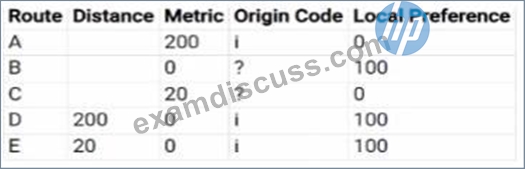
- A. Option E
- B. Option A
- C. Option B
- D. Option D
- E. Option C
Answer: A
Explanation:
In BGP, the route marked with a ">" symbol is the best route that is chosen based on BGP attributes in the following order: highest weight (Cisco-specific), highest local preference, originated by BGP running on the local router, shortest AS path, lowest origin type, lowest MED, eBGP over iBGP, closest IGP neighbor, and lowest BGP router ID. Based on the table provided, Option E would be marked with a ">" symbol as it has the highest local preference of 100 which is a decisive factor in the BGP best path selection process.
NEW QUESTION # 39
A customer is evaluating device profiles on a CX 6300 switch. The test device has the following attribute: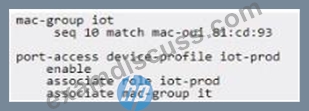
* MAC address=81:cd:93:13:ab:31
The test device needs to be assigned the "lot-prod'' role, in addition the "lot-default" role must be applied for any other device connected lo interface 1/1/1. This is a lab environment with no configuration of any external authentication server for the test.
Given the configuration example, what is required to meet this testing requirement?
- A. Enter the command "port-access fallback-role lot-default globally
- B. Enter the command "port-access onboarding-method precedence" to set device profiles with a lower precedence.
- C. Enter the command "port-access device-profile mode block-until-profile-applied" globally.
- D. Enter the command "pot-access device-profile mode block-until-profile-applied"" for interface 1/1/1.
Answer: A
Explanation:
The fallback role is used as a default role in the absence of a specified role or when an authentication server is not available. Given the scenario, where the test device with MAC address 81:cd:93:13:ab:31 needs to be assigned to "iot-prod" and other devices to "iot-default", and considering there is no external authentication server configured for the test, the appropriate action would be to set a global fallback role that applies to all devices connecting to the network. This ensures that any device that does not match the specific device profile will inherit the "iot-default" role. Since the configuration for a specific MAC address (81:cd:93:xx:xx:xx) to associate with the "iot-prod" role is already in place, setting the fallback role globally accommodates the requirement for other devices.
NEW QUESTION # 40
A Windows device attempts to connect to an 802.1X network but it is not receiving the correct role. TEAP has been configured asthe only authentication method in ClearPass.The wireless configuration is correct.
Exhibit.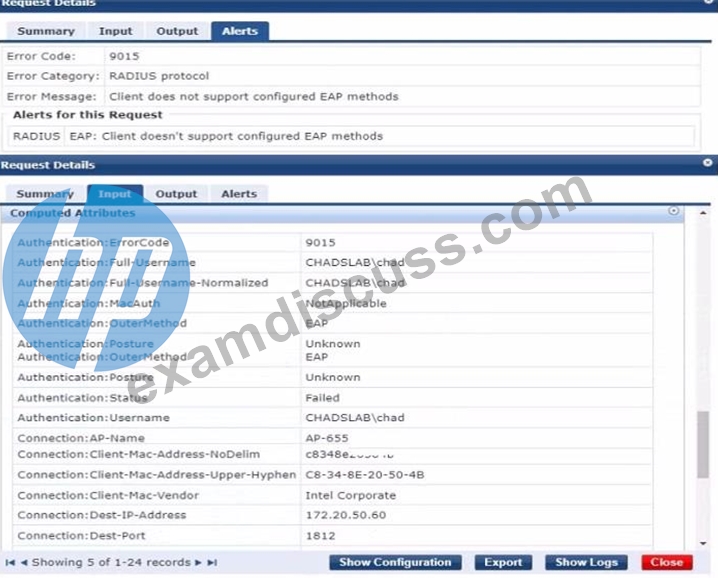
What is me mostlikelycause?
- A. 802.1X is not compatible with TEAP in windows device
- B. ClearPass requires a second authentication method.
- C. Only machine authentication should be configured on the Windows device
- D. The Windows device needs 10 De configured tor TEAP.
Answer: D
Explanation:
The issue likely stems from the Windows device not being configured to use TEAP (Tunneled Extensible Authentication Protocol) as specified in the ClearPass configuration. TEAP is an EAP method that encapsulates an inner EAP method for secure authentication. The Windows device must have TEAP enabled and correctly configured in its network settings to authenticate successfully on the network using ClearPass.
NEW QUESTION # 41
Your customer is requesting a4-ciass LAN queuing model tor QoS. Following best practices, match the PHB/DSCP values to the application types.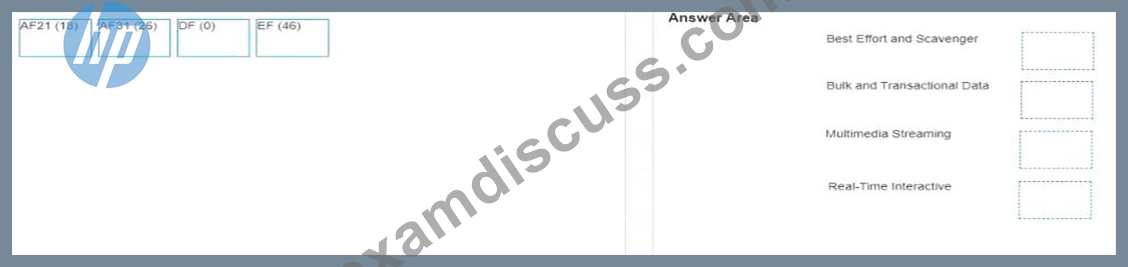
Answer:
Explanation: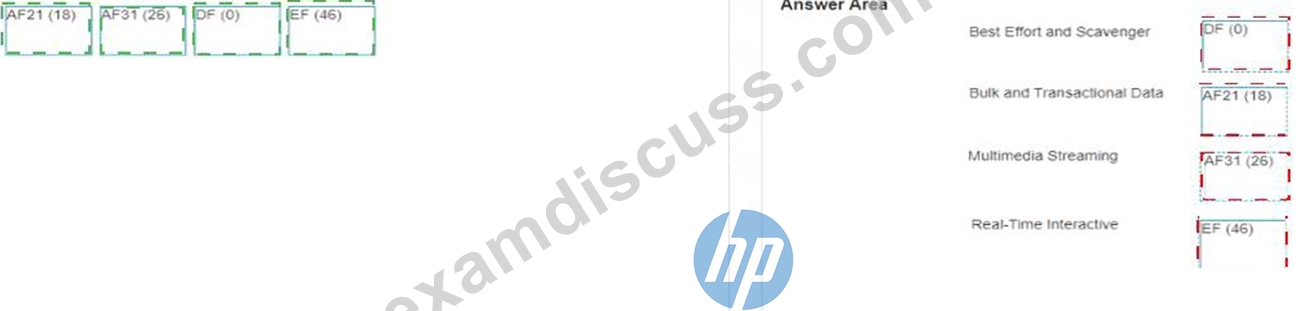
Explanation:
Best Effort and Scavenger =DF (0)Bulk and Transactional Data =AF21 (18)Multimedia Streaming =AF31 (26)Real-Time Interactive =EF (46)
NEW QUESTION # 42
A customer is evaluating device profiles on a CX 6300 switch. The test device has the following attributes:
* MAC address = 81:cd:93:13:ab:31
* LLDP sys-desc = iotcontroller
The test device is being assigned to the ''lot-dev'' role However, the customer requires the "lot-prod'' role be applied.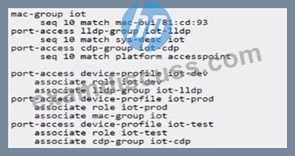
Given the configuration, what is causing the "iot-dev" role to be applied to the device'?
- A. The test device does not support CDP.
- B. An external RADIUS server is unreachable.
- C. The LLDP system description matches the IIdp-group configuration.
- D. The device-profile precedence order is not configured.
Answer: C
Explanation:
In device profile configuration, the device role is often determined by matching attributes such as MAC address, LLDP system description, and CDP information against defined conditions. The test device is being assigned the "iot-dev" role because its LLDP system description matches the 'iot-lldp' group configuration that is associated with the 'iot-dev' role.
NEW QUESTION # 43
A customer is deploying a new warehouse with AP-634 APs inthe unitedStates with mobile devices that can operate in the 6GHz spectrum All testing and RF analyses were performed during the POC using AP-635 APs In a different location During the deployment, they noticed fewer 6GHz channels were broadcasting in the air.
Why would the AP-634 deployment have a lesser amount of broadcasting channels?
- A. The AP-635 APs received different allowable 6GHz channels from the AFC service versus the AP-634 APs due to the POC running in a different location.
- B. The AP-634 APs cannot broadcast an 6Gnz channels due to regulatory restrictions.
- C. The AP-634 APs do not have an advanced subscription.
- D. The AP-634 AP's persona was configured in the Central group as Standard Power.
Answer: A
Explanation:
In the United States, the operation in the 6GHz band for Wi-Fi devices such as the AP-634 and AP-635 is regulated by the Automated Frequency Coordination (AFC) system, which determines the channels that can be used based on the location. Since the Proof of Concept (POC) was conducted in a different location using AP-635 APs, the allowable channels identified by the AFC service for that location would be different than the channels allowed for the actual deployment location of the AP-634 APs. This would result in a different set of broadcasting channels being available for use in the new warehouse deployment.
NEW QUESTION # 44
You configured" a bridgedmode SSID with WPA3-Enterprise and EAP-TLS security. When you connect an Active Directory joined client that has valid client certificates. ClearPass shows the following error.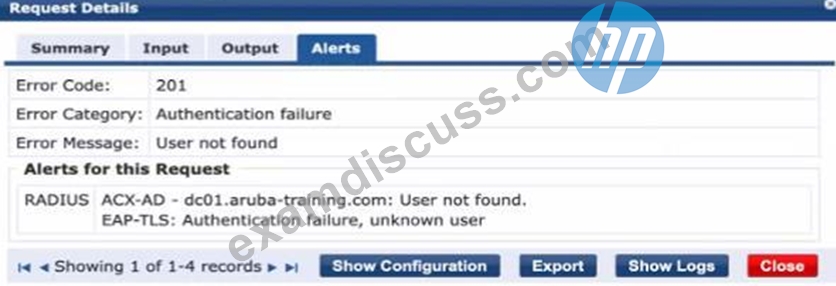
What is needed to resolve this issue?
- A. Recreate the SSID m tunneled mode.
- B. Configure ClearPass to trust the client certificate.
- C. Enable authorization in your Authentication Method.
- D. Modify your ACX-AD authentication source to include the UPN in the search.
Answer: D
Explanation:
The error message "User not found" indicates that the authentication source, in this case, Active Directory (AD), is not able to locate the user account based on the current search parameters. This often occurs when the User Principal Name (UPN) that the client is using to authenticate is not included in the search parameters of the AD authentication source within ClearPass. By modifying the AD authentication source to include the UPN in the search, ClearPass will be able to correctly locate the user account and proceed with the authentication using the valid client certificates.
NEW QUESTION # 45
A customer's infrastructure is set up to use both primary and secondary gateway clusters on the SSID profile cased on best practices. Why do they have an equal split of their 120 APs across the primary and secondary gateway clusters?
- A. The secondary gateway cluster is a homogeneous cluster with six nodes.
- B. The primary and secondary gateway clusters are up. and the cluster preemption is enabled
- C. The primary and secondary gateway clusters are up. but the cluster preemption Is not enabled
- D. The primary gateway cluster is a heterogeneous cluster with six nodes.
Answer: C
Explanation:
When cluster preemption is not enabled, access points (APs) will not automatically fail back to the primary gateway cluster once it is up again after having failed over to the secondary. This would result in an equal split of APs across primary and secondary clusters if both clusters are operational. Without preemption, there's no automatic rebalancing of APs back to the primary cluster, leading to the current distribution.
NEW QUESTION # 46
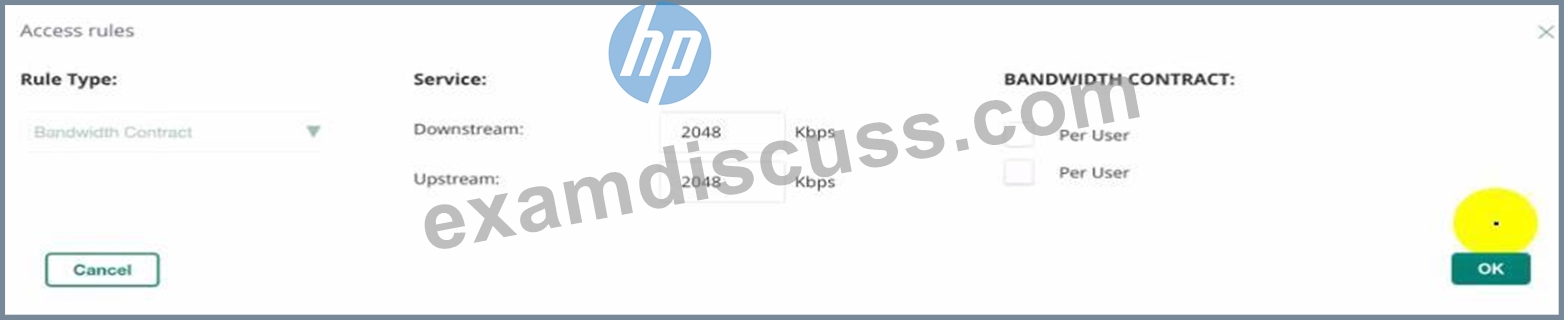
Which option shows the correct Banawidth Control for 1024 kbpsdown and 2048 Kops up for the SSID?
- A.

- B.

- C.

- D.
Answer: C
Explanation:
The correct Bandwidth Control settings for 1024 Kbps down and 2048 Kbps up for the SSID are shown in Option D. In Option D, the downstream is set at 1024 Kbps and the upstream at 2048 Kbps, both configured per user, which matches the requested configuration. This setup ensures that each user has a guaranteed bandwidth allocation of the specified rates when connected to the SSID, providing a controlled and predictable user experience.
NEW QUESTION # 47
The wireless administrator for a college campus is gelling reports of connectivity issues when students are working outdoors.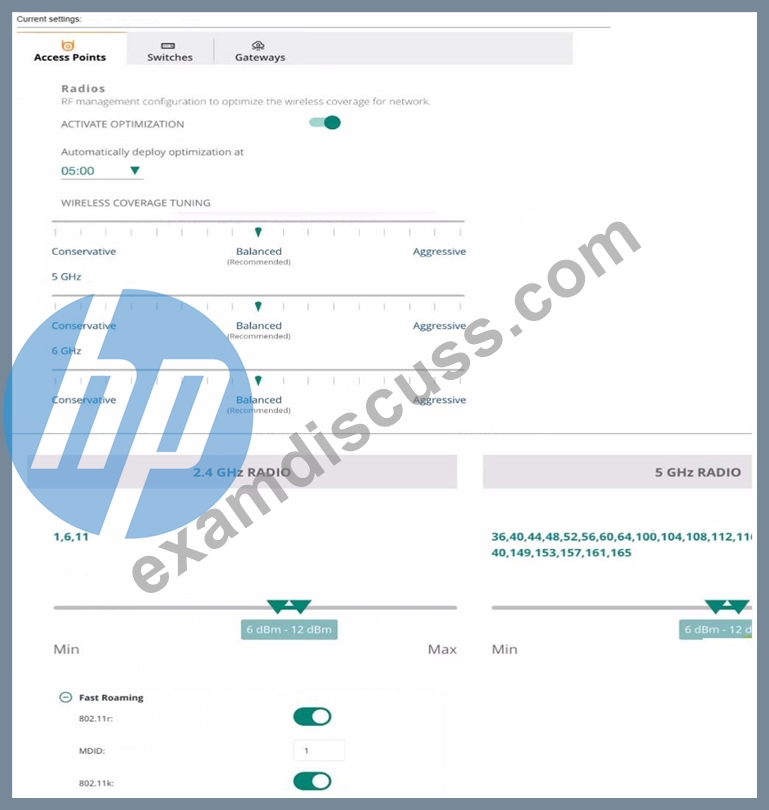
Reviewing the settings above, watch change is needed to align with best practices?
- A. Disable 802 11r.
- B. increase 5Gnz TX power range Min/Max.
- C. Disable 802 11k.
- D. increase 5 GHz wireless coverage tuning to Aggressive.
Answer: B
Explanation:
To address connectivity issues when students are working outdoors, increasing the transmission (TX) power range for the 5GHz radios can help improve signal strength and coverage. The setting shown indicates a conservative approach to power settings, which might not provide sufficient coverage for outdoor areas. By increasing the power range, you can extend the wireless signal reach, which aligns with best practices for outdoor wireless coverage.
NEW QUESTION # 48
A network administrator wants to configure an 802 1X supplicant for a wireless network that includes the following:
1. AES encryption
2. EAP-MSCHAPv2-based user and machine authentication
3. validation of server certificate in Microsoft Windows 10
The network administrator creates a WLAN profile and selects the change connection settings option Then the network administrator changes the security type to Microsoft Protected EAP (PEAP) and enables user and machine authentication under Additional Settings.
What must the network administrator do next to accomplish the task?
- A. Change default RC4 encryption for AES
- B. Enable server certificate validation
- C. Enable user authentication
- D. Change the security type to Microsoft: Smart Card or other certificate.
Answer: B
Explanation:
When configuring an 802.1X supplicant for wireless network access with Microsoft Windows 10, enabling server certificate validation is a critical step to ensure the security of the authentication process. Server certificate validation helps prevent man-in-the-middle attacks by ensuring the RADIUS server presenting the certificate is the correct server that the client expects to communicate with.
NEW QUESTION # 49
A customer has deployed an AOS 10 mobility gateway cluster consisting of three controllers at a single site The WLAN is configured to tunnel wireless device traffic to the AOS 10 mobility cluster The clients are authenticated by ClearPass using WPA3-Enterprise (opmode wpa3-aes-ccm-128). The security team has requested the ability to force a wireless device to reauthenticate using ClearPass.
Which steps are required to ensure ClearPass can consistently initiate a change of authorization against an AOS 10 mobility cluster, including during gateway failover scenarios? (Select two)
- A. modify NAS IPv4 address under Security - Advanced - RADIUS Client
- B. set cluster mode to Auto Site under High Availability - Cluster configuration
- C. enable manual cluster configuration under High Availability - Cluster Configuration
- D. enable Dynamic Authorization CoA under High Availability - Cluster Configuration
- E. modify WLAN - SSID - VLAN - Mode Configuration
Answer: A,D
Explanation:
To ensure that ClearPass can initiate a Change of Authorization (CoA) consistently, it's important to enable dynamic authorization to allow RADIUS CoA messages to be processed. This setting typically falls under the high-availability cluster configuration to ensure that it persists across gateway failovers. Additionally, the NAS IP address must be configured under RADIUS client settings to ensure that the correct IP address is used for RADIUS communications, which is necessary for CoA to function correctly.
NEW QUESTION # 50
......
HP HPE7-A07 Exam Syllabus Topics:
| Topic | Details |
|---|---|
| Topic 1 |
|
| Topic 2 |
|
| Topic 3 |
|
| Topic 4 |
|
| Topic 5 |
|
| Topic 6 |
|
| Topic 7 |
|
| Topic 8 |
|
| Topic 9 |
|
Actual HPE7-A07 Exam Recently Updated Questions with Free Demo: https://www.examdiscuss.com/HP/exam/HPE7-A07/
Valid HPE7-A07 exam with HP Real Exam Questions: https://drive.google.com/open?id=1Vxehzgyr9l_QFVDBdVzodUdp1ycazAz-